
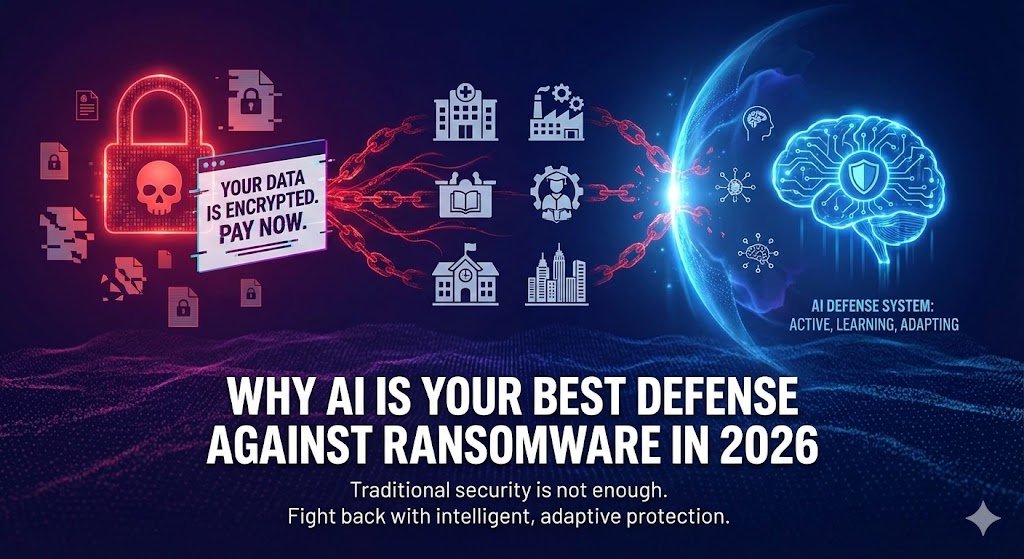
Ransomware isn’t just a cybersecurity problem anymore—it’s a business continuity crisis that can shut down operations in minutes and cost millions to resolve.
Healthcare systems have turned patients away because encrypted records made treatment impossible. Manufacturers have halted production lines for weeks. School districts have lost years of student data. Government agencies have watched citizen services grind to a halt. And increasingly, small businesses facing their first attack simply close their doors permanently because recovery costs exceed their resources.
No sector is immune, and the threat is accelerating. Cybercriminals have industrialized ransomware into a profitable, scalable business model complete with affiliate programs, customer service desks, and guaranteed encryption keys (assuming you pay).
Traditional security measures—firewalls, antivirus software, signature-based detection—were built for a different era. They’re necessary but no longer sufficient. The modern ransomware threat requires defenses that can think, learn, and adapt as quickly as the attackers themselves.
That’s where artificial intelligence enters the picture—not as a silver bullet, but as a fundamental shift in how organizations detect, respond to, and prevent ransomware attacks.
The Limitations of Traditional Security
To understand why AI matters, you need to understand where traditional approaches fail.
Signature-based antivirus tools work by recognizing known threats—like checking IDs against a wanted poster. But ransomware developers constantly create new variants, often hundreds per day. By the time security vendors identify a new strain, update their signatures, and distribute them to customers, that ransomware has already infected thousands of systems.
Perimeter defenses like firewalls assume attacks come from outside. But modern ransomware frequently enters through legitimate channels—phishing emails, compromised credentials, or supply chain vulnerabilities. Once inside the network, attackers move laterally, escalate privileges, and encrypt systems while perimeter defenses watch helplessly.
Manual security monitoring can’t scale. A mid-sized organization might generate millions of security events daily. Human analysts can’t review them all, which means threats hide in the noise until they execute—often during off-hours or weekends when security teams are smallest.
These aren’t failures of execution. They’re structural limitations of detection methods designed for predictable, slow-moving threats. Ransomware is neither.
How AI Changes the Game: Behavioral Detection
AI’s most powerful capability in ransomware defense is behavioral analysis—the ability to learn what normal activity looks like across your network and instantly flag deviations.
Instead of asking “does this file match a known ransomware signature?” AI asks “is this behavior consistent with how this user, system, or application normally operates?”
Here’s what that looks like in practice:
A finance employee typically accesses 10-15 files daily during business hours. Suddenly, her account starts touching hundreds of files per minute at 2 AM, with each file being modified and renamed with a random extension. Traditional tools might not recognize the specific malware, but AI instantly flags this as anomalous behavior—likely ransomware encryption in progress.
An application server normally communicates with three internal databases. It suddenly initiates connections to an external IP address and begins transferring gigabytes of data. Signature-based tools might miss this if the connection looks legitimate, but AI recognizes the behavioral deviation—potentially data exfiltration preceding double extortion ransomware.
A user account that usually logs in from Chicago starts authenticating from Romania, attempts to access file shares it’s never touched before, and disables security monitoring tools. AI doesn’t need to know the specific attack technique—the behavioral pattern itself triggers alerts.
This behavioral approach catches zero-day ransomware—brand new variants that no security vendor has seen before. That’s a game-changer when attackers are constantly innovating.
Speed That Saves Organizations
When ransomware executes, every second counts. The difference between detecting encryption after 30 seconds versus 30 minutes can mean the difference between recovering 50 files and recovering 50,000 files.
AI-powered security platforms automate incident response in ways human teams physically cannot:
Automated isolation: When AI detects ransomware behavior, it can instantly isolate the infected system from the network—cutting the attacker’s access in seconds without waiting for human approval.
Process termination: AI can identify and kill malicious processes before encryption completes, potentially stopping ransomware mid-execution.
Real-time alerting: Security teams receive immediate notifications with context about what’s happening, which systems are affected, and what automated actions have been taken.
Priority ranking: Not all alerts are equally urgent. AI prioritizes based on risk severity, ensuring analysts focus on genuine threats instead of drowning in false positives.
This speed isn’t just about technology—it’s about containment. Ransomware often spreads laterally through networks, encrypting one system after another. Automated AI response can contain attacks before they cascade, dramatically reducing damage and recovery costs.
Predicting What’s Coming Next
AI doesn’t just react to current threats—it predicts future ones by analyzing patterns across global cybersecurity data.
Machine learning models can identify emerging ransomware families, new attack techniques, and evolving tactics by processing massive volumes of threat intelligence from around the world. When a new ransomware variant appears in Europe, AI systems can recognize similar patterns before that variant reaches your network in North America.
This predictive capability enables proactive defense:
- Identifying vulnerable systems before attackers exploit them
- Recognizing new phishing techniques as they emerge
- Detecting command-and-control infrastructure before it’s widely used
- Spotting initial access attempts that precede full ransomware deployment
Organizations using AI-driven threat intelligence can strengthen defenses, patch vulnerabilities, and adjust security policies ahead of attacks rather than cleaning up after them.
Stopping Double Extortion Before Data Leaves
Modern ransomware attacks frequently involve double extortion—attackers encrypt your data and steal copies to threaten public release if you don’t pay. This dramatically raises the stakes because even perfect backups don’t prevent data exposure.
AI excels at detecting the data exfiltration phase of these attacks:
Unusual data movement: AI monitors data flow patterns and flags large transfers to external servers, especially to uncommon destinations or during unusual hours.
Unauthorized access patterns: When accounts suddenly access sensitive files they’ve never touched before—often the precursor to data theft—AI raises alerts.
Volume anomalies: A user downloading 50GB of data when their normal activity involves accessing individual documents triggers immediate investigation.
By catching data theft attempts before information leaves the network, AI helps organizations avoid the worst outcomes of double extortion—regulatory fines, legal liability, reputation damage, and competitive intelligence loss.
Making Backups Actually Work
Backups are fundamental to ransomware recovery, but attackers know this. Sophisticated ransomware specifically targets backup systems, either encrypting backup files or deleting them entirely to force payment.
AI strengthens backup resilience in several ways:
Integrity monitoring: AI continuously verifies that backup files remain uncorrupted and unencrypted, alerting teams immediately if backups are compromised.
Suspicious change detection: If systems suddenly start modifying backup configurations, disabling backup jobs, or deleting backup files, AI flags this behavior as potentially malicious.
Optimal recovery point identification: After an attack, AI can analyze backup versions to identify the safest, most complete recovery point—minimizing data loss and downtime.
Faster restoration: AI can prioritize which systems to restore first based on business criticality, orchestrating recovery processes more efficiently than manual efforts.
Effective backups aren’t just about having copies—they’re about ensuring those copies remain accessible and uncorrupted when you need them most. AI provides that assurance.
Reducing the Human Error Factor
Here’s an uncomfortable truth: most ransomware infections start with human mistakes.
An employee clicks a phishing link. A contractor uses a weak password. A manager downloads a malicious attachment. Someone ignores a security warning because they’re rushing to meet a deadline.
AI can’t eliminate human error, but it can dramatically reduce the damage:
Advanced phishing detection: AI-powered email security analyzes message content, sender behavior, and contextual clues to catch phishing attempts that traditional filters miss. These systems consider writing style, urgency language, impersonation attempts, and suspicious links—blocking phishing emails before they reach inboxes.
Behavioral analytics: AI monitors how users typically work and flags anomalies. If an account starts behaving like an attacker—accessing unusual systems, downloading sensitive files, or attempting lateral movement—AI can require additional authentication or restrict access.
Credential monitoring: AI tracks credential usage patterns to detect compromised accounts. When stolen credentials are used from unusual locations, at strange times, or in atypical ways, AI can challenge or block access.
Smart security controls: AI can adapt security measures based on risk—requiring stronger authentication for sensitive actions, limiting file access when anomalous behavior is detected, or blocking high-risk downloads automatically.
By augmenting human judgment with AI-powered guardrails, organizations reduce the likelihood that a single mistake becomes a catastrophic breach.
What AI Can’t Do (Yet)
It’s critical to be realistic about AI’s limitations in ransomware defense:
AI isn’t autonomous: While AI can automate many responses, human oversight remains essential. Security teams still make strategic decisions, tune AI systems, and handle complex incidents.
AI requires training: Machine learning models need quality data to learn what “normal” looks like in your environment. This takes time and careful configuration.
AI can be evaded: Sophisticated attackers are developing techniques to avoid AI detection, such as moving very slowly to avoid behavioral anomalies or using legitimate tools in malicious ways.
AI isn’t a replacement: AI works best as part of a comprehensive security strategy that includes employee training, regular patching, network segmentation, access controls, and incident response planning.
AI has costs: Implementing AI-powered security tools requires investment in technology, training, and ongoing management. For smaller organizations, this can be challenging.
The key insight: AI is an incredibly powerful tool that makes security teams more effective, but it doesn’t eliminate the need for good security fundamentals.
What This Means for Your Organization
If you’re responsible for cybersecurity or business continuity, the ransomware threat demands serious consideration of AI-powered defenses:
Evaluate your current detection capabilities: Can your existing tools catch zero-day ransomware? How quickly can you detect and contain an active attack? If the answers aren’t confident, AI-powered solutions deserve investigation.
Don’t wait for perfect: AI security tools have matured significantly. While no solution is perfect, waiting for ideal technology means remaining vulnerable to current threats.
Prioritize behavioral detection: Look for security platforms that emphasize behavioral analysis rather than just signature-based detection. This capability is key to catching novel ransomware variants.
Test your response speed: Run tabletop exercises or simulations to understand how quickly your team can respond to ransomware. If containment takes hours rather than minutes, automated AI response can dramatically improve outcomes.
Consider managed services: For organizations without deep security expertise, managed detection and response (MDR) services with AI capabilities can provide advanced protection without requiring in-house AI specialists.
The Bottom Line
Ransomware has evolved from a nuisance into an existential threat for many organizations. Attackers have industrialized their operations, created sophisticated encryption techniques, and developed business models that make ransomware highly profitable.
Defending against this threat requires equally sophisticated technology. AI provides capabilities that traditional security tools simply cannot match—behavioral detection that catches zero-day threats, automated response that contains attacks in seconds, predictive analysis that anticipates new techniques, and intelligent monitoring that reduces human error.
AI isn’t a silver bullet—no technology is. But when combined with strong security practices, employee awareness, regular system updates, and solid backup strategies, AI significantly strengthens an organization’s ability to prevent ransomware infections and minimize damage when attacks occur.
In the ongoing battle against cybercrime, AI has rapidly become one of the most effective tools in the cybersecurity arsenal. The question isn’t whether to adopt AI-powered defenses—it’s how quickly you can implement them before the next ransomware attack hits your organization.
Because with ransomware, it’s not if, it’s when. And when that moment comes, you’ll want every advantage AI can provide.
Has your organization experienced a ransomware attack or near-miss? What security measures proved most valuable? Share your experience in the comments.

Ali Tahir is a growth-focused marketing leader working across fintech, digital payments, AI, and SaaS ecosystems.
He specializes in turning complex technologies into clear, scalable business narratives.
Ali writes for founders and operators who value execution over hype.