

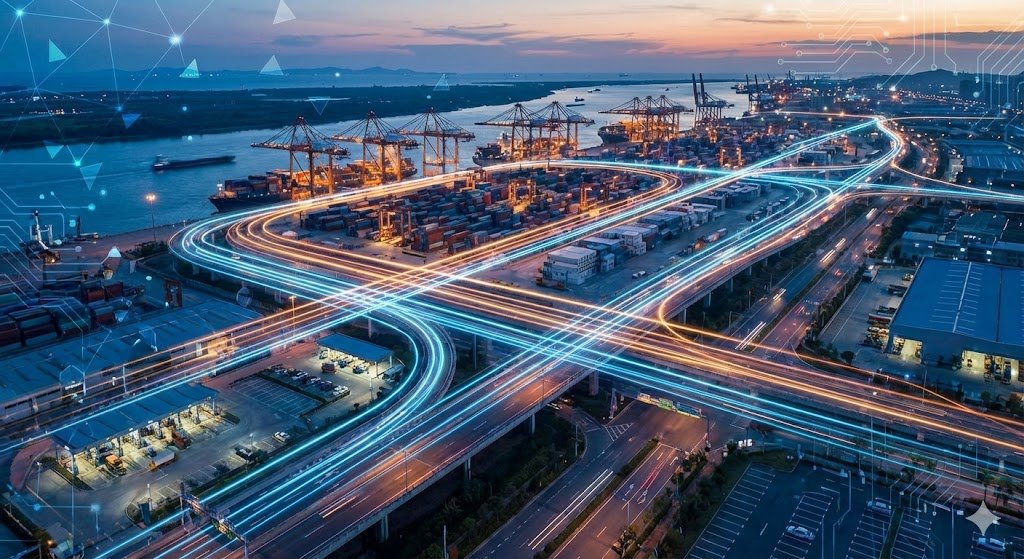
There’s something profoundly satisfying about watching inefficiency get dismantled, line by line, algorithm by algorithm.
I’ve spent enough time observing digital transformation across industries to know that the most powerful changes rarely announce themselves with fanfare. They seep in gradually—through a smarter route here, a predictive alert there—until one day you look up and realize the entire game has changed.
Logistics is having one of those moments right now.
The Problem Worth Solving
Here’s what keeps logistics operators up at night: trucks running empty on return journeys, routes planned on gut feeling rather than data, customers calling every hour asking “where’s my shipment?”, and margins so thin that a single miscalculation can wipe out a week’s profit.
The traditional logistics playbook was built for a different era—one where phone calls and spreadsheets were cutting-edge technology. But we’re now moving freight in a world that generates more data in a day than previous generations saw in a lifetime. The question isn’t whether AI will transform logistics. It’s whether companies can transform fast enough to survive.
What the Leaders Are Doing
DHL has deployed AI-powered predictive maintenance across its vehicle fleet, analyzing sensor data to predict mechanical failures before they happen. The result? Fewer breakdowns, less downtime, and significant cost savings. Their AI systems also optimize warehouse operations, predicting peak times and adjusting staffing accordingly.
Maersk, the shipping giant, uses AI for demand forecasting and container positioning. Their algorithms predict where containers will be needed weeks in advance, dramatically reducing the repositioning costs that used to bleed billions from the industry.
Amazon, unsurprisingly, has turned its logistics operation into an AI showcase. From predictive inventory placement (moving products closer to where they’re likely to be ordered) to drone delivery experiments, they’re essentially using AI to compress time and space.
But here’s what interests me more: it’s not just the giants making moves.
The Wahyd Logistics Approach: Building Intelligence into the Foundation
What Wahyd Logistics is doing offers a particularly instructive case study—not because they’re the biggest player, but because their approach demonstrates how AI can be architectural rather than ornamental.
Let me break down what I find compelling:
The Empty Miles Problem: Roughly 20-30% of truck miles are “empty miles”—vehicles returning without cargo after a delivery. It’s an economic and environmental disaster hiding in plain sight. Wahyd’s intelligent load matching doesn’t just pair shipments with trucks; it thinks ahead, considering return journeys and creating circular efficiency. The AI isn’t replacing human decision-making; it’s seeing patterns humans couldn’t possibly track across thousands of shipments.
Dynamic Pricing That Actually Works: Their automated bidding system does something traditional pricing models struggle with—it adapts. Market conditions in Lagos differ from those in Lahore. Seasonal demand fluctuates. A human pricing team might update rates quarterly; Wahyd’s AI adjusts continuously, learning from every transaction. This isn’t about undercutting competitors; it’s about finding the true market-clearing price in real-time.
Predictive Routing: Here’s where it gets interesting. Wahyd’s route optimization doesn’t just look at distance. It factors in traffic patterns, weather forecasts, vehicle condition, driver hours, delivery windows, and historical delay data. It’s thinking several moves ahead, like a chess engine for logistics. When a monsoon is forecast for a particular region three days out, the system is already rerouting shipments to avoid the disruption.
The Visibility Gap: The AI chatbot integration is clever not because chatbots are novel—they’re not—but because it solves a real pain point. In logistics, “Where’s my shipment?” is the most asked question, and it historically required a human to check multiple systems. By automating this through AI that can parse natural language queries and pull real-time data, Wahyd frees human expertise for problems that actually require human judgment.
Forecasting as a Competitive Weapon: The predictive analytics piece might be their most strategic investment. Supply chain disruptions are inevitable—port congestion, strikes, natural disasters. The winner isn’t the company that never faces disruption; it’s the one that sees it coming and adapts fastest. Machine learning models that can forecast demand spikes or identify potential bottlenecks three weeks out provide something invaluable: time to act.
The Broader Pattern
What unites these examples—from DHL’s maintenance algorithms to Wahyd’s load matching—is a shift from reactive to predictive operations. Traditional logistics was about responding to what happened. AI-powered logistics is about shaping what happens next.
The technology is also democratizing capabilities that used to require massive scale. A mid-sized operator using platforms like Wahyd can now access route optimization and demand forecasting that would have required a dedicated data science team and millions in custom software development just five years ago.
The Human Element
Here’s where I get pushback: “But won’t AI eliminate jobs?”
The honest answer is: it will eliminate tasks, not necessarily jobs. The driver still drives, but the route is smarter. The dispatcher still dispatches, but with better information. The customer service rep still handles complex issues, but the routine queries are automated.
The transformation is more subtle than replacement. It’s augmentation—giving humans better tools to make better decisions faster. The companies that understand this, that invest in training their workforce to work alongside AI rather than in competition with it, will have a significant advantage.
What’s Next
We’re still early in this transformation. Current AI implementations in logistics are primarily focused on optimization and prediction within existing frameworks. The next wave will be more radical.
Imagine autonomous vehicles coordinating their routes in real-time, forming dynamic convoys to reduce fuel consumption. Picture warehouses where AI doesn’t just optimize picking routes but redesigns the entire layout daily based on shifting demand patterns. Consider supply chains that self-heal, automatically rerouting around disruptions before human operators even notice the problem.
Wahyd and others are building the foundation for this future. The route optimization algorithms they’re refining today will inform the autonomous freight networks of tomorrow. The load matching systems are learning patterns that will eventually enable fully automated freight marketplaces.
The Strategic Imperative
If I were advising a logistics company today, I’d say this: the cost of AI adoption is high, but the cost of AI hesitation is existential.
Your competitors—whether established players like DHL or nimble platforms like Wahyd—are training their algorithms on real-world data right now. Every day you wait is a day your competitors’ AI gets smarter while yours doesn’t exist yet. The data advantage compounds over time.
Start somewhere. Even small implementations—a chatbot for customer queries, basic route optimization, predictive maintenance alerts—begin the learning process. They generate data, reveal insights, and build organizational muscle for the larger transformations ahead.
A Final Thought
The most elegant solutions often feel obvious in retrospect. Of course logistics should use AI to match loads with carriers. Of course we should predict delays before they happen. Of course routes should optimize in real-time.
But “obvious” is only obvious once someone builds it.
What excites me about this moment in logistics isn’t just the technology—it’s watching an entire industry shed decades of accumulated inefficiency. There’s something deeply satisfying about that.
The trucks will still roll. The cargo will still move. But waste—of time, fuel, money, and effort—is quietly being designed out of the system, one algorithm at a time.
And that quiet revolution? It’s just getting started.
