
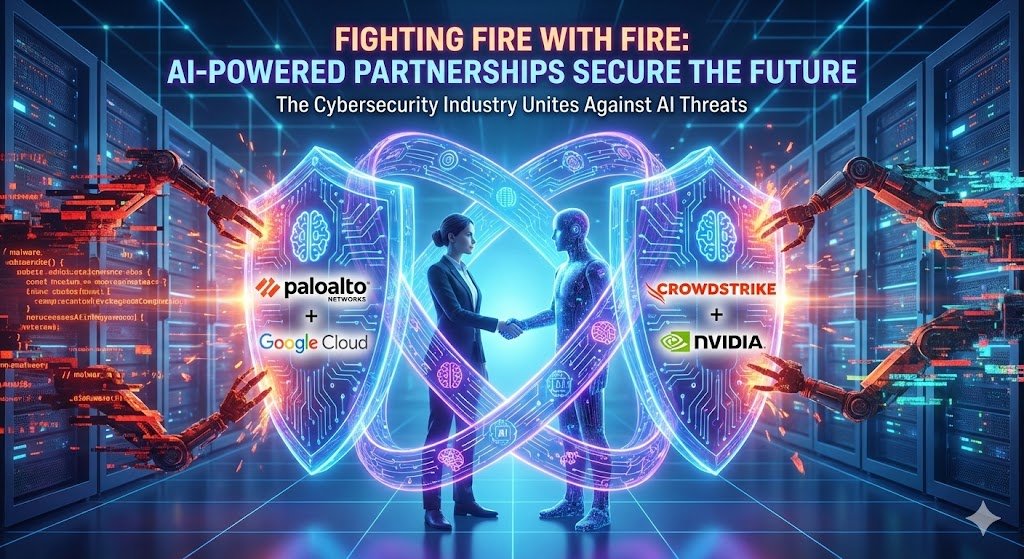
From Palo Alto-Google Cloud to CrowdStrike-NVIDIA, strategic partnerships are reshaping how companies defend against attacks. The playbook? Meet fire with fire.
By Ali T. | Dec 23, 2025
If you’re building cybersecurity products in 2025, going it alone is starting to look like a losing strategy. The latest wave of industry news makes one thing clear: the companies racing to secure AI infrastructure are doing it through sprawling partnerships that combine cloud platforms, AI chips, security software, and threat intelligence into unified defense systems.
And the dollars backing these alliances are staggering. The generative AI cybersecurity market in the US alone is projected to explode from $2.79 billion in 2025 to $28.28 billion by 2033, according to SNS Insider — driven by cloud adoption, regulatory pressure, and increasingly sophisticated attacks.
The math is simple: As enterprises pile into AI and cloud infrastructure, attackers are exploiting the same systems. So security vendors are teaming up to fight back with AI-powered defenses that can match the speed and scale of the threats.
Palo Alto Networks and Google Cloud go all-in
The most prominent recent example came last Friday, when Palo Alto Networks and Google Cloud announced a major expansion of their partnership focused squarely on securing AI workloads. The collaboration combines Google’s AI infrastructure — including Vertex AI and its new Agent Engine — with Palo Alto’s Prisma AIRS platform, which the company bills as a comprehensive AI security suite.
The timing isn’t subtle. Palo Alto’s own State of Cloud Report, released in December, found that 99 percent of respondents experienced at least one attack on their AI infrastructure over the past year. Translation: If you’re running AI at scale, you’re getting targeted.
The expanded partnership aims to address that reality by embedding security at every layer: from code to cloud, from development tools to live workloads. That includes AI posture management for visibility, runtime security for real-time defense, agent security for autonomous systems, red teaming for proactive testing, and model security for vulnerability scanning.
Palo Alto is also integrating its VM-Series firewalls and Prisma SASE platform deeper into Google Cloud’s infrastructure, creating what the companies describe as a “simplified and unified security experience” — corporate speak for “we pre-integrated everything so you don’t have to deal with compatibility nightmares.”
CrowdStrike and NVIDIA bring AI agents to the edge
Meanwhile, CrowdStrike and NVIDIA are taking a different angle: deploying always-on AI agents at the edge to defend critical infrastructure in real time.
The collaboration leverages NVIDIA’s Nemotron models, NeMo toolkits, and NIM microservices alongside CrowdStrike’s Charlotte AI AgentWorks platform. The goal is to create autonomous security agents that continuously learn and can operate closer to where data is generated — think data centers and controlled environments — rather than relying on centralized cloud processing.
“AI is transforming cybersecurity, and defenders need speed and edge intelligence to outpace the adversary,” said George Kurtz, CrowdStrike’s CEO and founder. Jensen Huang, NVIDIA’s CEO, framed it even more dramatically: “Cybersecurity in the era of AI demands intelligence that thinks at the speed of machines.”
The partnership also integrates CrowdStrike’s Falcon LogScale, Onum, and Pangea platforms with NVIDIA’s accelerated computing infrastructure, creating what the companies describe as a “unified telemetry pipeline” for high-fidelity security data. The idea is that enterprises can fine-tune models locally, maintain control of sensitive data, and comply with regional data sovereignty requirements — all while letting AI agents handle threat detection and response autonomously.
Smaller players betting big on alliances
It’s not just the giants making moves. Cycurion (NASDAQ: CYCU), a smaller player in AI-powered IT solutions, has been building out its own strategic alliance with iQSTEL (NASDAQ: IQST) since September. The partnership aims to combine iQSTEL’s global telecom platform — which spans 600+ operators worldwide — with Cycurion’s AI-driven cybersecurity expertise.
The companies are co-developing threat intelligence applications and identity-driven security solutions for telecom operators, financial institutions, and enterprise clients across more than 20 countries. They expect to roll out joint products in Q1 and Q2 2026.
Cycurion also earned a spot on the 2025 MSSP 250 ranking, debuting at No. 116 among the world’s top managed security service providers — a signal that smaller firms can still compete if they pick the right partners.
Why partnerships matter now
There’s a clear pattern here: No single company has all the pieces needed to secure modern AI infrastructure. Cloud platforms provide the compute and data storage. Chipmakers supply the hardware acceleration. Security vendors bring threat detection and response capabilities. And telecom companies control the networks tying it all together.
Integrating those layers used to be a customer problem. Now, vendors are doing the heavy lifting upfront through pre-vetted, engineered-to-work-together solutions. That’s partly about removing friction for enterprises racing to deploy AI. But it’s also about speed — because attackers aren’t waiting for companies to figure out their security stack.
Palo Alto’s finding that 99 percent of organizations running AI have been attacked underscores the urgency. And as enterprises push AI workloads to the edge, into data centers, and across hybrid multicloud environments, the attack surface only expands.
AI defending AI
The core irony running through all these partnerships is that the same technology creating new vulnerabilities is also being positioned as the solution. AI models can be exploited, poisoned, or tricked into leaking sensitive data. So the defense? More AI — agents that learn continuously, detect threats in real time, and respond autonomously.
Whether that’s sustainable long-term remains an open question. But for now, the cybersecurity industry’s answer to AI-powered attacks is clear: fight fire with fire, and don’t fight alone.
The partnerships are multiplying. The funding is pouring in. And the message from vendors is consistent: If you’re not securing your AI infrastructure with AI-powered defenses built by companies working together, you’re already behind.

Ali Tahir is a growth-focused marketing leader working across fintech, digital payments, AI, and SaaS ecosystems.
He specializes in turning complex technologies into clear, scalable business narratives.
Ali writes for founders and operators who value execution over hype.