
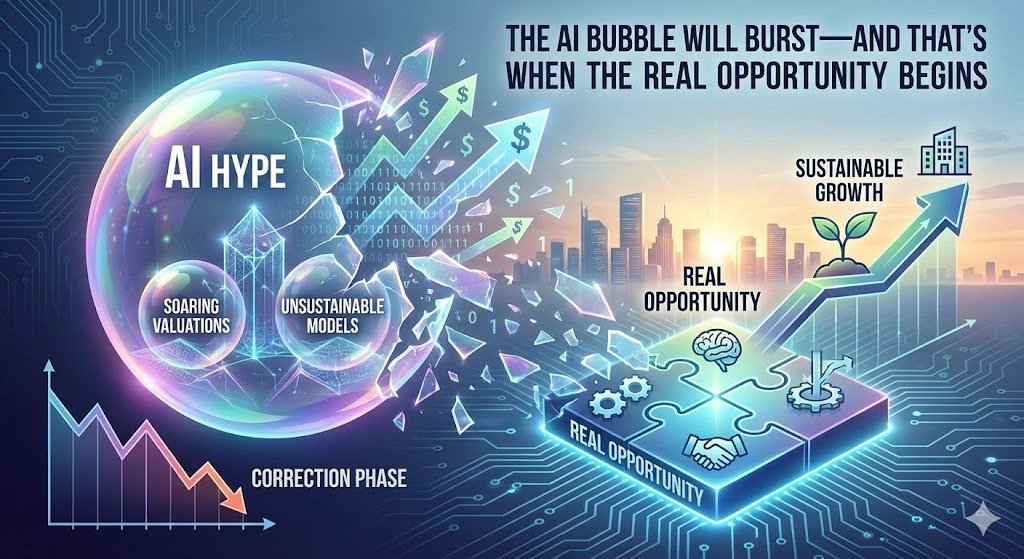
Every transformative technology follows the same arc: wild enthusiasm, soaring valuations, inevitable correction, then sustainable growth. AI won’t be the exception.
We’ve watched this pattern play out before—with the internet in the late 1990s, social media in the 2010s, and countless innovations in between. Each time, the pattern is identical: early excitement inflates expectations beyond what’s immediately achievable, capital floods in, unsustainable business models proliferate, and then reality asserts itself through a painful but necessary correction.
AI is accelerating through this cycle right now. Despite unprecedented hype, most AI companies focused on applications remain unprofitable. Expenses far outpace revenue. Valuations eclipse dot-com-era excesses. Meanwhile, business fundamentals lag, regulation races to catch up, and companies are still figuring out sustainable unit economics.
The correction is coming. But here’s what most people miss: the burst isn’t the end—it’s the beginning of the real opportunity.
When the hype fades and investment cools, when costs drop and models mature, when standards emerge and regulation brings clarity—that’s when AI’s true value will crystallize. The companies that thrive in that next phase won’t be the ones with the flashiest demos or biggest funding rounds. They’ll be the ones that combine intelligent technology with deep understanding of human behavior, turning disruption into durable advantage.
The question isn’t whether you’ll survive the correction. It’s whether you’re building for the growth that comes after.
Why Most AI Projects Are Failing Right Now
Before we talk about what comes next, we need to understand why so many current AI initiatives are disappointing.
The pattern is remarkably consistent: companies adopt AI as an upgrade—a faster chatbot, a smarter workflow, an automated process. They start with the technology and then search for problems it might solve. The initiative launches with great fanfare, delivers underwhelming results, frustrates customers, and eventually gets quietly shelved.
The fundamental error? Starting with the tech instead of the purpose.
Here’s the question most organizations skip: Do we know exactly what we’re trying to solve in the customer experience, and is it aligned to our brand?
That’s not a technology question—it’s a strategy question. And getting it wrong means your AI implementation, no matter how sophisticated technically, will feel disconnected from what customers actually value about your brand.
The Smarter Approach: Brand First, AI Second
A better path begins with defining the brand experience you want to create. What kind of emotional and functional connection are you building with customers? What makes your brand distinctive in how it makes people feel?
Only after answering those questions should you decide where AI fits naturally to support that experience.
AI shouldn’t be the star of the show—it should enhance the experience or quietly power human performance.
Even better, deploy AI to drive revenue and business insight. Give your teams real-time data, next-best-action recommendations, and contextual cues that help them deliver better outcomes for customers. When AI strategy is clear and appropriately integrated with human touchpoints, you get the best of both worlds: efficiency and emotion, speed and sensitivity.
This isn’t just philosophy—it’s practical differentiation. In a world where everyone has access to similar AI models, your competitive advantage comes from how intelligently you integrate that technology into experiences that reflect your unique brand promise.
Designing AI That Actually Fits Your Customers
Great customer experience depends on context, which means AI needs to flex accordingly. One-size-fits-all AI implementations inevitably disappoint because they ignore the diversity of customer needs, preferences, and circumstances.
To design AI that genuinely enhances your brand, consider four critical dimensions:
Age and Lifecycle Preferences
Younger generations expect frictionless digital journeys. They want to resolve issues without picking up a phone, speaking to a human, or waiting for business hours. For them, AI-powered self-service isn’t a compromise—it’s the preferred experience.
Older customers may still value hearing a personal voice or having a face-to-face interaction, especially for complex or high-stakes decisions. For them, being routed to AI when they want human connection feels dismissive rather than efficient.
Your AI strategy needs to accommodate both, offering digital-first paths for those who prefer them while ensuring easy access to human support for those who value it.
Cultural Expectations
What feels delightfully efficient in one region might feel impersonal or tone-deaf in another. Cultural norms around communication style, formality, directness, and relationship-building vary dramatically across markets.
AI systems need localization that goes deeper than language translation. They need to understand cultural context, adjust interaction style appropriately, and recognize when cultural norms make human interaction non-negotiable.
When AI drives your customer touchpoints globally, cultural intelligence becomes as important as artificial intelligence.
Perceived Complexity
A process that feels straightforward to your internal teams can feel overwhelming to customers navigating something high-stakes for the first time—purchasing insurance, managing healthcare, making financial decisions, dealing with legal issues.
In these moments, customers don’t just need efficiency. They need confidence, reassurance, and the sense that someone is looking out for their interests. AI can provide information and streamline processes, but knowing when to introduce human expertise is crucial.
The perceived complexity from the customer’s perspective should determine your automation strategy, not the technical simplicity from your operations perspective.
Journey Intentionality
Where AI shows up in the customer journey matters enormously. Deploy it at the wrong moments, and it creates frustration rather than value.
Offering troubleshooting tips when someone just wants their problem fixed immediately doesn’t feel helpful—it feels like an obstacle between them and resolution. Providing an AI chatbot when someone is trying to report a serious issue or handle an emergency feels dismissive rather than efficient.
Being intentional about when AI steps in, when it steps back, and how it hands off to humans creates experiences where technology enhances rather than impedes.
Getting these four dimensions right allows AI to amplify your brand’s personality rather than flatten it. You create a spectrum of interaction modes—from fully automated to fully human—calibrated to each customer’s specific needs and circumstances.
The result: fewer dead ends, more trust, and smoother experiences across every channel.
The Coming AI Volume Avalanche
Here’s an assumption most companies make that’s about to be proven spectacularly wrong: that adding AI will reduce inbound customer volume.
The logic seems sound—better self-service tools mean fewer calls, fewer tickets, fewer complaints. In reality, the opposite typically happens. Every time you make access easier, usage grows.
Consider what’s coming: personal AI assistants that can comparison shop across 50 mortgage providers simultaneously, initiating applications and negotiating terms on your behalf. AI agents that pursue refunds, file complaints, or contest charges that you previously would have let go because the hassle wasn’t worth your time.
What used to require significant personal time investment becomes frictionless and automated. Suddenly, interactions that customers would have skipped become trivial to initiate.
In that world, every organization faces more customer interactions than ever before—not fewer.
This isn’t theoretical. Early signs of the AI-driven transaction avalanche are already appearing. Smart businesses are preparing by:
Automating routine interactions ruthlessly. Free your people to handle genuinely complex, high-value work that requires judgment, empathy, and creative problem-solving.
Designing seamless human handoffs. When an issue needs human touch, the transition should feel natural and instantaneous. Customers shouldn’t have to repeat information or re-explain their situation.
Using AI insights to fix root causes. Don’t just respond faster to the same problems repeatedly. Analyze patterns to prevent issues entirely, reducing unnecessary interactions for both you and customers.
Building systems that scale non-linearly. Your infrastructure needs to handle 10x volume increases without 10x cost increases. That’s only possible with intelligent automation.
When done right, this shift is liberating. Your systems handle the noise; your people handle the nuance. You deliver faster responses while building stronger relationships.
But if you’re unprepared for the volume increase, AI becomes a crisis accelerator rather than a solution.
Five Moves to Lead After the Bubble Bursts
So how do you position your organization not just to survive the AI correction, but to dominate the growth phase that follows?
It comes down to five strategic choices that separate leaders from followers:
1. Start With Empathy, Not Technology
Anchor every AI initiative in your brand promise and customer experience strategy. Ask what emotional and functional outcomes you’re trying to create before asking what technology to deploy.
This keeps AI implementations aligned with what customers actually value about your brand, preventing the disconnected, frustrating experiences that plague so many current AI projects.
2. Pilot Small, Scale Smart
Experiment in low-risk, high-volume areas with very clearly defined success metrics. Learn what actually works in your specific context before making large-scale commitments.
Build from proven successes rather than rolling out comprehensive AI strategies based on vendor promises or competitor pressure. Let evidence guide scaling decisions.
3. Blend Human and Machine Intentionally
Treat AI and people as teammates, each contributing what they do best. Don’t frame this as replacement—frame it as augmentation that makes human expertise more impactful.
Design explicit collaboration models: AI handles data analysis, pattern recognition, and routine execution while humans provide judgment, empathy, creativity, and accountability. Clear role definition prevents confusion and builds trust.
4. Practice Radical Transparency
Show customers how AI works, when humans step in, and how you protect their data. Transparency about AI usage builds trust rather than eroding it.
Many companies hide AI behind interfaces designed to seem human, believing this creates better experiences. Research increasingly suggests the opposite: customers appreciate knowing when they’re interacting with AI and what it can and cannot do for them.
5. Invest in Your Foundation
Data quality, infrastructure resilience, and AI explainability are long-term competitive advantages that only compound over time.
While competitors chase the latest models and features, building robust data pipelines, clean datasets, and systems that can articulate their reasoning creates capabilities that are harder to replicate and more valuable as AI matures.
These aren’t just technology choices—they’re leadership choices that shape how your brand earns trust and how your people feel empowered to deliver value.
Why the Post-Correction Winners Will Be Different
When the AI bubble bursts and investment cools, a specific type of company will emerge as the dominant players—and they won’t look like today’s AI darlings.
The winners will be organizations that:
Built for sustainable unit economics rather than growth-at-all-costs. When funding becomes scarce, profitable AI implementations become the only AI implementations that survive.
Focused on customer outcomes rather than technology metrics. Companies that measured AI success by customer satisfaction, retention, and lifetime value rather than deployment speed or model sophistication.
Integrated AI into brand identity rather than treating it as a separate initiative. Organizations where AI enhancement feels native to the brand experience rather than tacked on.
Prepared infrastructure for volume rather than assuming AI would reduce interactions. Systems designed to handle the coming avalanche of AI-initiated customer contacts.
Maintained human connection even while automating extensively. Brands that used AI to make human expertise more accessible and impactful rather than replacing it entirely.
Notice what’s missing from this list: having the most advanced models, the largest AI teams, or the earliest adoption. Those advantages are temporary. The sustainable advantages come from strategic clarity about how AI creates customer value.
The Bottom Line
The AI correction is inevitable. Valuations will compress. Funding will tighten. Unprofitable business models will fail. Hype will dissipate.
But none of that changes AI’s fundamental potential to transform customer experience—it just separates companies using AI strategically from those chasing hype.
The real opportunity emerges after the correction, when costs drop, standards solidify, regulations clarify, and sustainable business models crystallize. That’s when AI transforms from disruptive novelty into foundational infrastructure.
The companies preparing for that moment now—building for brand alignment rather than feature parity, designing for human-AI collaboration rather than automation alone, investing in foundations rather than chasing trends—will be positioned to turn the next AI supercycle into durable competitive advantage.
The bubble will burst. That’s not a crisis to fear—it’s a milestone that marks the transition from hype to value, from speculation to strategy, from disruption to transformation.
Are you building for the rebound, or are you riding the bubble?
How is your organization preparing for the post-hype phase of AI? What sustainable AI strategies are you implementing? Share your approach in the comments.

Ali Tahir is a growth-focused marketing leader working across fintech, digital payments, AI, and SaaS ecosystems.
He specializes in turning complex technologies into clear, scalable business narratives.
Ali writes for founders and operators who value execution over hype.