
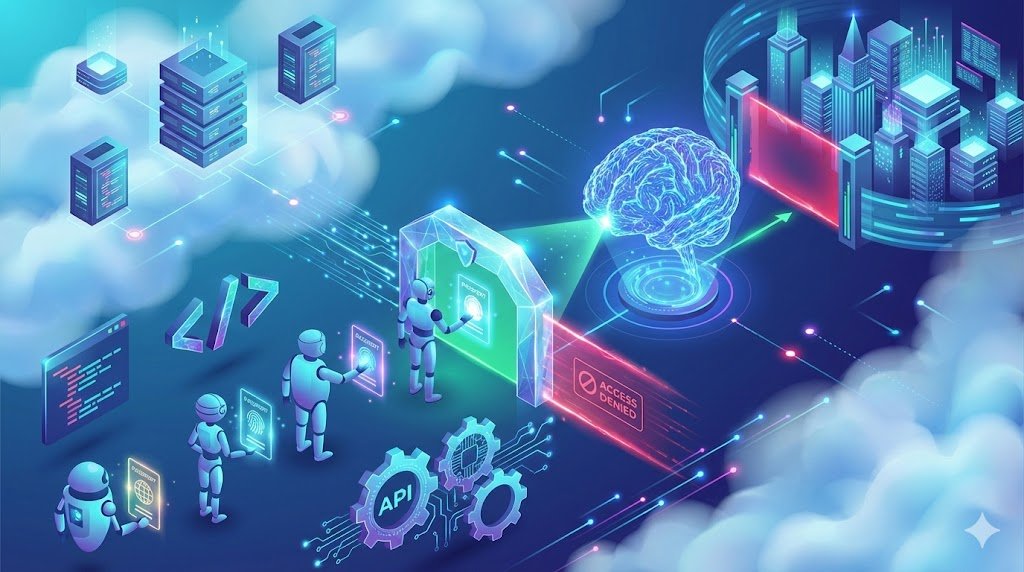
As organizations pile into cloud infrastructure, managing machine identities has become critical. The question is whether proactive AI security can actually prevent breaches, or if it’s just adding another layer to an already complex problem.
By Ali T. | Dec 24, 2025
Here’s a question most organizations haven’t thought to ask: How many non-human identities do you have on your network right now? Not user accounts — machine identities. API keys, service tokens, encryption certificates, OAuth credentials. The automated identities that let your systems talk to each other without human intervention.
If you don’t know the answer, you’re not alone. And that’s becoming a problem.
Non-Human Identities (NHIs) — essentially machine credentials that authenticate system-to-system interactions — have quietly proliferated across enterprise networks as companies migrate to cloud infrastructure. Each microservice, container, automation script, and CI/CD pipeline potentially has its own identity. And unlike human users who log off at the end of the day, these identities run 24/7, often with broad permissions and minimal oversight.
Security professionals are increasingly recognizing NHI management as a critical gap in cybersecurity strategies. And naturally, the proposed solution involves artificial intelligence.
What NHIs actually are (and why they matter)
Think of an NHI as a digital passport system. The “secret” — an encrypted password, token, or key — acts as the passport itself. The permissions granted by a destination server function as visas, allowing or denying access based on predefined security protocols.
The problem is scale. A typical enterprise might have thousands of these machine identities scattered across cloud environments, many of them provisioned on the fly by developers and never properly decommissioned. Some have excessive permissions. Others use hardcoded credentials that never rotate. And because they’re not attached to individual employees, they’re harder to track and audit than traditional user accounts.
When attackers compromise an NHI, they don’t need to phish credentials or exploit vulnerabilities in user-facing applications. They can move laterally through systems using legitimate machine credentials, making detection significantly harder.
The proactive AI pitch
Enter AI-powered NHI management, which promises to transform reactive security postures into proactive ones. The value proposition hits familiar notes:
Predictive capabilities: AI-driven insights can reveal patterns that human analysts might miss, offering early warnings about potential security incidents before they materialize into breaches.
Real-time adaptation: AI continuously updates its models based on new data, theoretically keeping defenses current against novel threats.
Resource optimization: By automating routine security tasks like secrets rotation and access reviews, AI frees up security teams to focus on strategic initiatives.
Enhanced visibility: AI provides consolidated views of NHIs across cloud environments, streamlining access management and governance.
The promised benefits are compelling: reduced risk, improved compliance, increased efficiency, and cost savings through automation. Organizations implementing these systems report being able to identify vulnerabilities and potential attack vectors through AI-driven insights that weren’t visible using traditional tools.
Lifecycle management: The unglamorous reality
NHI management isn’t a one-time deployment. It’s a continuous process spanning discovery, classification, monitoring, threat detection, and remediation. And each stage presents challenges.
Discovery alone is non-trivial. Machine identities can be scattered across multiple cloud platforms, buried in configuration files, hardcoded in legacy applications, or hidden in container orchestration systems. AI-driven discovery tools can scan environments to inventory these identities, but they’re only as good as the access they’re granted and the patterns they’re trained to recognize.
Classification requires understanding ownership, permissions, usage patterns, and business criticality. Who provisioned this API key? What systems does it access? Is it still needed? AI can help answer these questions by analyzing access logs and usage patterns, but it requires high-quality data and proper tagging to be effective.
Unlike point solutions like secret scanners — which only detect exposed credentials — comprehensive NHI management platforms attempt to provide holistic visibility. The theory is that AI-driven analytics can predict potential security incidents and recommend preventive measures based on behavioral analysis.
Bridging the security-dev gap
One of the more interesting applications of NHI management is closing the gap between security and R&D teams. This disconnect creates vulnerabilities when developers spin up services with broad permissions for convenience, security teams lack visibility into what’s being provisioned, and nobody has a clear inventory of which machine identities exist.
AI-powered NHI management platforms offer a shared framework for secure development. By integrating security protocols early in the development process — the “shift-left” approach — organizations can ensure new applications meet security standards before hitting production.
AI facilitates this by providing actionable insights relevant to both security professionals and developers. For example, when a developer requests credentials for a new service, AI can recommend appropriate permission scopes based on similar services, flag potential compliance issues, and automate the provisioning and rotation workflows.
Industry-specific complications
NHI management requirements vary significantly by industry. Financial services need stringent controls around transaction data to maintain customer trust and meet regulatory demands. Healthcare organizations must protect patient information while adhering to HIPAA. DevOps and SOC teams benefit from automating repetitive tasks to focus on strategic incident management.
As these industries continue adopting cloud technologies, effective NHI management becomes more critical. But “effective” looks different depending on regulatory environment, risk tolerance, and existing infrastructure. A healthcare provider’s NHI management strategy will prioritize different things than a fintech startup’s.
The trust question
So can organizations actually trust proactive AI security to prevent data breaches?
The honest answer is: it depends. AI can absolutely improve NHI management by providing visibility, automating routine tasks, and identifying anomalies that humans might miss. But it’s not a silver bullet.
AI systems are only as good as the data they’re trained on and the access they’re granted. If your NHI inventory is incomplete, AI won’t magically discover everything. If your access logs are sparse or poorly structured, AI can’t analyze patterns that aren’t captured. And critically, AI requires human judgment for final decision-making — it can recommend revoking an unused credential, but someone needs to verify it won’t break a critical system.
The real value proposition isn’t that AI prevents all breaches through mystical predictive powers. It’s that AI makes comprehensive NHI management practical at scale — something that was effectively impossible when security teams had to manually track thousands of machine identities across distributed cloud environments.
Building the foundation
What’s clear is that as organizations continue migrating to cloud infrastructure, NHI management can’t remain an afterthought. Machine identities are proliferating faster than most security teams can track them manually. And attackers have noticed.
AI-powered platforms offer a path forward by automating discovery, monitoring usage patterns, enforcing least-privilege access, rotating secrets automatically, and flagging anomalies for investigation. Whether that constitutes “trust” is perhaps the wrong question.
The better question might be: Can organizations afford not to use AI for NHI management, given the scale and complexity of modern cloud environments?
For most enterprises, the answer is increasingly no. The attack surface is too large, the identities too numerous, and the stakes too high to rely on manual processes and spreadsheets.
AI won’t prevent every breach. But it might prevent the ones caused by expired certificates, overprivileged service accounts, and hardcoded credentials that nobody remembered to rotate. And in cybersecurity, preventing the preventable is already a significant win.

Ali Tahir is a growth-focused marketing leader working across fintech, digital payments, AI, and SaaS ecosystems.
He specializes in turning complex technologies into clear, scalable business narratives.
Ali writes for founders and operators who value execution over hype.