

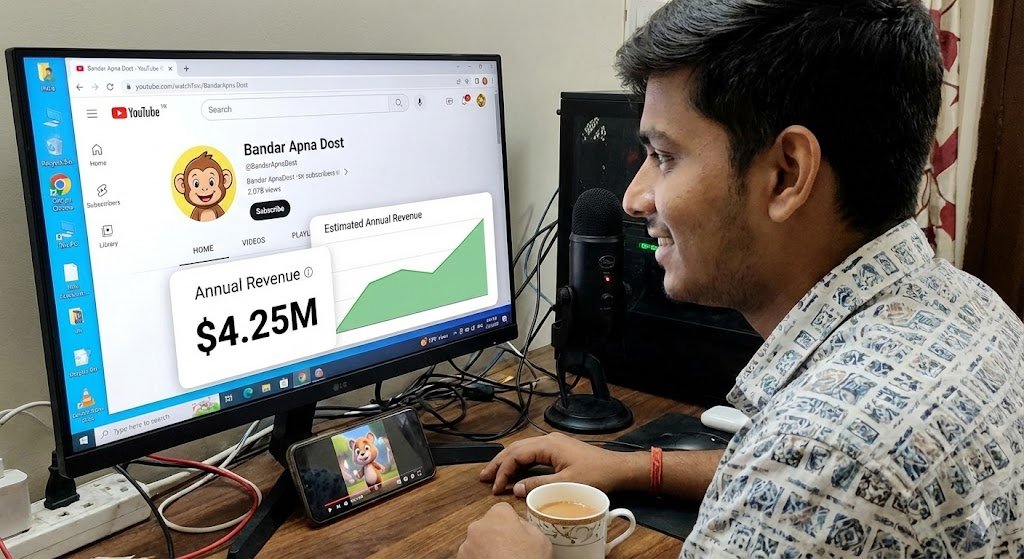
“Bandar Apna Dost” has racked up 2 billion views with AI-produced Shorts, becoming the world’s most profitable automated content channel
YouTube’s algorithm has a new favorite creator — and it’s not human.
“Bandar Apna Dost,” an Indian channel churning out AI-generated short videos, has amassed 2.07 billion views and an estimated $4.25 million (£3.15 million) in annual revenue, making it the world’s most profitable purveyor of what critics call “AI slop.”
The channel’s meteoric rise highlights a seismic shift on YouTube, where artificial intelligence is rapidly rewriting the economics of content creation — and raising urgent questions about whether the platform is prioritizing automation over human creativity.
The AI content explosion
India has emerged as the epicenter of YouTube’s AI content boom. Research from Kapwing reveals that over 20% of videos recommended to new YouTube Shorts accounts are either AI-produced or qualify as “AI slop” — a term used to describe low-effort, algorithmically optimized content generated with minimal human input.
Bandar Apna Dost has perfected the formula. By blending AI-generated visuals with simple storytelling frameworks, the channel produces a constant stream of Shorts designed to trigger YouTube’s recommendation algorithm. The results speak for themselves: 2.07 billion views and projected annual profits of ₹37 crore ($4.25 million).
That revenue figure, calculated at an exchange rate of ₹87 per dollar, positions the channel as not just the most-viewed AI content hub globally, but also the most lucrative of its kind.
The creator backlash
While audiences — particularly in India — are clearly consuming AI-generated content in massive volumes, the trend has sparked intense debate among traditional creators who say automated spam is saturating the platform and making it harder for human-made content to gain traction.
The complaint isn’t just aesthetic. When YouTube’s algorithm increasingly surfaces AI-generated videos over traditional content, it fundamentally changes the economics of creation. Channels that invest significant time, money, and creative energy into original productions find themselves competing against operations that can generate dozens of videos per day at minimal cost.
Yet YouTube’s leadership remains committed to embracing AI. CEO Neal Mohan has repeatedly defended the platform’s technological direction, arguing that AI tools will democratize content creation by enabling a wider range of people to produce videos regardless of technical skill.
Mohan frames this as returning to “the early days of YouTube” when anyone with a camera could become a creator. He maintains that AI innovation will spark a new era of creativity while improving content discovery.
A permanent shift
Whether YouTube’s AI push represents creative democratization or a race to the bottom remains hotly contested. What’s undeniable is the financial impact. Channels like Bandar Apna Dost prove that AI-generated content can dominate viewership and generate substantial revenue at scale.
The channel’s success also reveals something about YouTube’s recommendation algorithm: it appears remarkably effective at surfacing AI content to receptive audiences, regardless of whether that content required traditional creative effort to produce.
For traditional creators watching AI channels rack up billions of views with minimal human input, the implications are sobering. If AI-generated “slop” can consistently outperform human-created content in YouTube’s algorithm, the incentive structure of the platform fundamentally shifts toward automation and volume over originality and craft.
Why it matters
Bandar Apna Dost’s $4.25 million empire represents more than one channel’s success — it’s a proof of concept for an entirely new content creation model. As AI generation tools become more sophisticated and accessible, we’re likely to see an explosion of similar operations attempting to replicate the formula.
The question facing YouTube is whether the platform can maintain its identity as a space for human creativity while simultaneously embracing AI-generated content that demonstrably drives massive engagement. Right now, the algorithm isn’t making moral distinctions — it’s surfacing whatever keeps users watching.
For creators who’ve spent years building audiences through traditional means, that’s cold comfort. The era of AI slop isn’t just arriving — according to the data, it’s already here, dominating the global stage and collecting millions in revenue along the way.
Whether YouTube’s bet on AI ultimately enriches or erodes the platform’s creative ecosystem won’t be clear for years. But for now, one thing is certain: the algorithm has spoken, and it’s chosen automation.
