
Alphabet’s deal for the clean energy developer marks a new approach in Big Tech’s race to secure electricity for data centers
Google is buying its way out of the electrical grid’s waiting list.
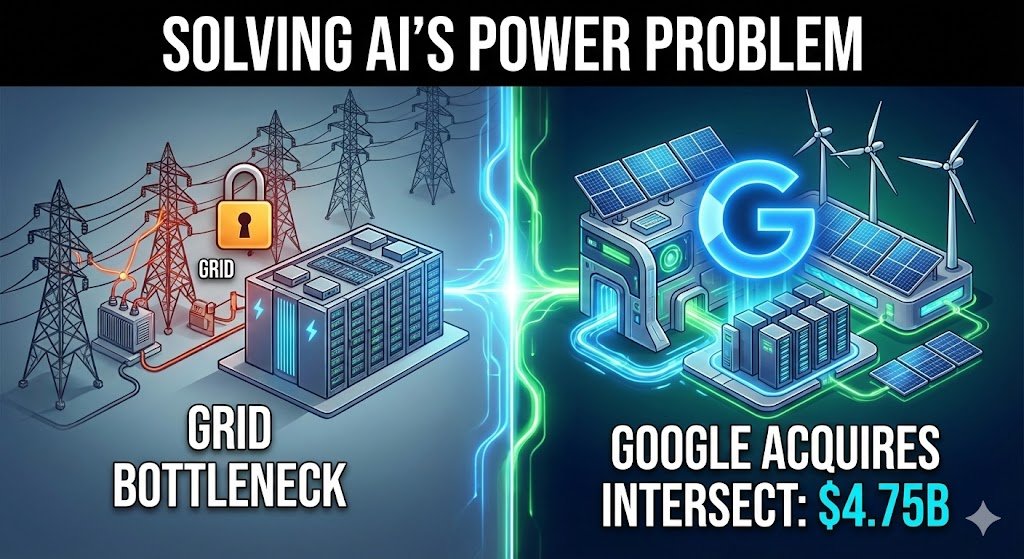
Alphabet announced Monday it will acquire Intersect, a clean energy developer and data center infrastructure company, for $4.75 billion in cash plus assumed debt. The deal gives Google a team capable of developing, building, and generating power directly alongside data centers — effectively bypassing the lengthy process companies typically face to connect new facilities to the grid.
For an industry increasingly bottlenecked by energy availability, the acquisition represents a fundamentally different strategy than what Microsoft and Amazon have pursued.
Why Google made the move
“AI today is stuck behind one of the slowest, oldest industries in the country: electric power,” wrote Intersect founder and CEO Sheldon Kimber in a blog post announcing the deal. “The country has racks full of GPUs that can’t be energized because there isn’t enough electricity for them.”
That bottleneck has become acute as AI workloads demand exponentially more power. Training large language models and running inference at scale requires data centers with massive electrical capacity — capacity that can take years to secure through traditional utility connections.
By acquiring Intersect outright, Google gains an internal capability to develop power generation alongside data center construction, potentially shaving years off deployment timelines.
Founded in 2016 and originally based in Beaverton, Oregon, Intersect relocated its headquarters to San Francisco earlier this year. The company has grown into a major player in utility-scale renewable energy, with significant assets in solar power and battery storage. It has raised more than $10 billion to date and already had a partnership with Google, which took a minority stake in a funding round last year.
How rivals are approaching the problem
Microsoft and Amazon are also racing to secure power for AI data centers, but neither has acquired a power developer outright.
Microsoft has signed large renewable energy deals and is restarting the Three Mile Island nuclear plant to supply its data centers. Amazon has secured a long-term agreement for nuclear power from the Susquehanna plant in Pennsylvania and is investing heavily in small modular reactor (SMR) technology.
Google’s approach — vertically integrating power development into its operations — represents a bolder bet that owning the capability will prove more valuable than contracting for it.
Deal structure and what happens next
The $4.75 billion cash deal plus assumed debt is expected to close in the first half of 2026. Intersect, which has more than 360 employees, will continue operating under its own brand with Kimber remaining as CEO.
Notably, Intersect’s operations in Texas and California will be carved out and remain with current investors including TPG Rise Climate and Climate Adaptive Infrastructure. That suggests Google is primarily interested in Intersect’s development capabilities and future projects rather than inheriting existing assets tied to specific geographies.
Why it matters
Energy has emerged as the defining constraint on AI infrastructure buildout. While semiconductor supply chains have gradually expanded and cloud providers have capital to spend, connecting data centers to reliable power sources remains a years-long process governed by utility planning cycles and grid capacity constraints.
Google’s move signals that the company believes vertical integration is the solution — that owning the capability to develop power generation will provide a competitive advantage over rivals still dependent on utility partnerships and power purchase agreements.
If the strategy works, it could reshape how Big Tech approaches infrastructure. Rather than leasing data center space or negotiating with utilities, cloud giants might increasingly own the entire stack: from power generation to cooling systems to the compute itself.
The bet also underscores how AI’s energy demands are forcing cloud providers to think like utility companies. Google is now in the business of not just running servers, but generating the electricity to power them — a reminder that the AI revolution depends as much on kilowatt-hours as it does on algorithmic breakthroughs.
For the Pacific Northwest, meanwhile, Intersect’s exit represents another high-growth tech company migrating to the Bay Area — though the deal ensures the company’s operational footprint will remain distributed across multiple regions as it continues building out renewable energy infrastructure nationwide.

Ali Tahir is a growth-focused marketing leader working across fintech, digital payments, AI, and SaaS ecosystems.
He specializes in turning complex technologies into clear, scalable business narratives.
Ali writes for founders and operators who value execution over hype.