

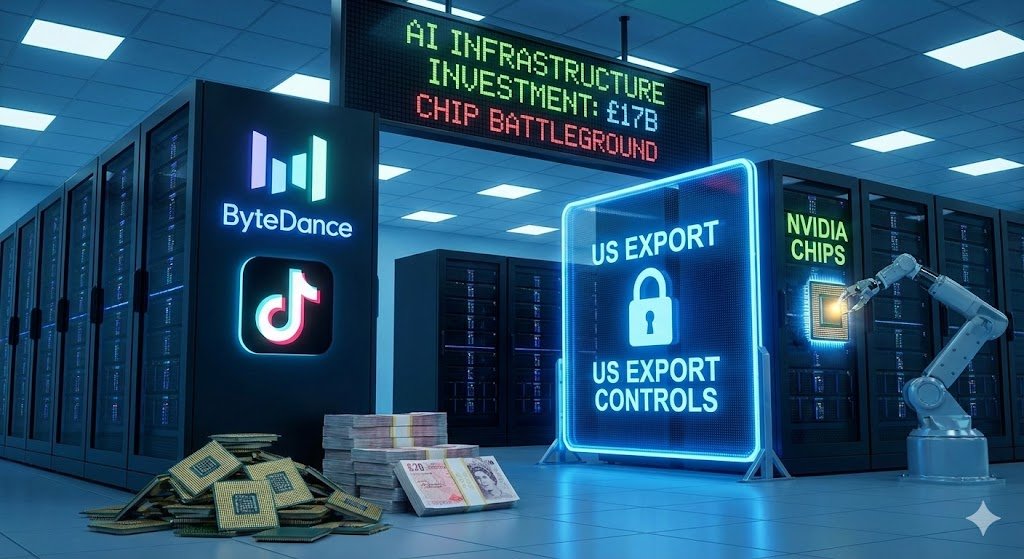
TikTok’s parent company is ramping up semiconductor spending even as US export controls complicate access to Nvidia’s cutting-edge chips
ByteDance is doubling down on AI — and betting big that it can compete globally despite being cut off from America’s best chips.
The Chinese tech giant is targeting around RMB160 billion (£17 billion) in capital expenditure for 2026, up from roughly RMB150 billion (£15.7 billion) this year, according to reports. Roughly half of that spending — about RMB85 billion (£8.9 billion) — will go toward AI processors used to train and run models across TikTok, its advertising tools, and cloud services.
The move underscores how rapidly AI infrastructure has become table stakes for consumer platforms, as companies race to embed generative capabilities into everything from search and content creation to ad targeting — all areas directly tied to revenue growth.
The chip dilemma
ByteDance’s aggressive spending comes with a major caveat: uncertainty over access to Nvidia’s most advanced hardware under US export controls.
The company is reportedly planning a trial purchase of around 20,000 Nvidia H200 processors — a less powerful alternative to Nvidia’s latest chips — following Donald Trump’s decision this month to allow limited sales to “approved customers” in China. If access to the H200 expands, sources say ByteDance could increase its 2026 AI budget even further.
Still, ByteDance remains far behind its US counterparts in raw spending power. Microsoft, Alphabet, Amazon, and Meta have collectively spent over $300 billion this year alone building the data centers needed to power their AI ambitions.
Efficiency as strategy
Export restrictions have forced Chinese tech companies like ByteDance and Alibaba to get creative, prioritizing efficiency by developing models that require less computing power and cost less to deploy.
But those constraints haven’t stopped ByteDance from dominating on the consumer side. Its “Doubao” chatbot has overtaken DeepSeek to become China’s most popular AI assistant by monthly users and downloads, according to QuestMobile. Goldman Sachs analysts report that ByteDance’s AI services are now the most widely used in China, with daily token consumption hitting 30 trillion in October — compared to Google’s 43 trillion globally.
The company is also pushing its Volcano Engine cloud platform to enterprise customers, setting up a direct collision course with Alibaba’s cloud division.
The private company advantage
ByteDance’s private ownership structure may be its secret weapon here. Without the quarterly earnings pressures faced by public companies, the firm has more latitude to invest aggressively and absorb short-term losses while building out long-term AI infrastructure.
Beyond chip purchases, ByteDance is spending billions to lease overseas data centers — a workaround that gives it legal access to Nvidia’s most advanced hardware outside China’s borders.
Why it matters
This spending spree highlights the emerging fault lines in the global AI race. While US tech giants enjoy unrestricted access to cutting-edge chips and can outspend competitors by orders of magnitude, Chinese firms are proving that constraints can breed innovation.
ByteDance is increasingly positioning AI not just as a feature but as the foundational engine driving both its consumer products and future revenue streams. As TikTok faces regulatory uncertainty in the US and competition intensifies globally, that AI infrastructure could determine whether the company can maintain its edge — or get left behind by rivals with deeper pockets and better chips.
The real test will come in 2026, when we’ll see whether efficiency and scale can compensate for being locked out of Silicon Valley’s semiconductor supply chain.
