
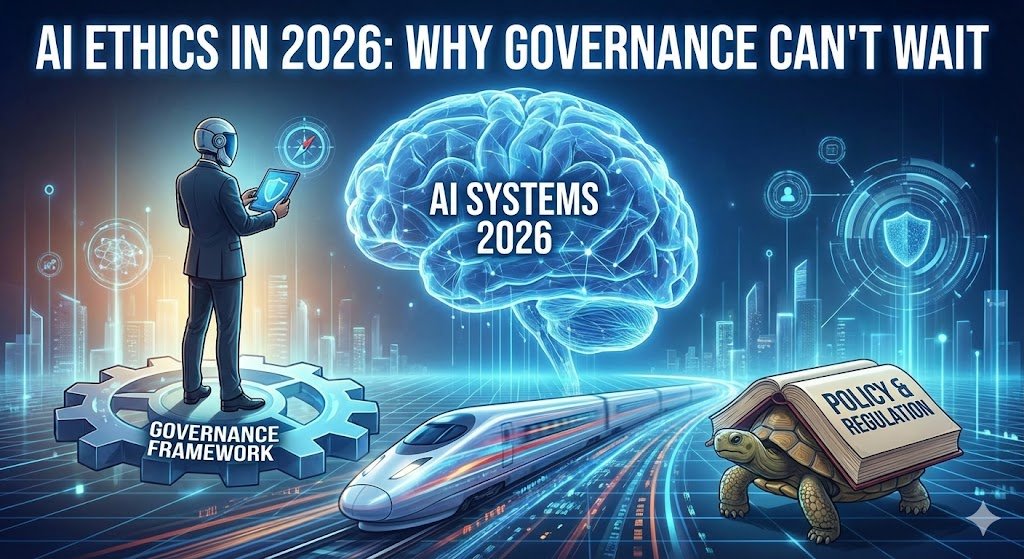
Here’s the uncomfortable truth about AI governance: by the time regulators write the rules, the technology has already moved three steps ahead.
We’re living in a strange in-between moment where innovation thrives precisely because comprehensive policies haven’t caught up yet. Companies are deploying increasingly autonomous systems, funneling massive datasets through opaque decision engines, and discovering—often too late—that a single oversight can cascade far beyond their internal tech stack.
The question isn’t whether regulation is coming. It’s how organizations build accountability frameworks that work right now, before the rules are written, while the systems they govern are evolving by the week.
Welcome to AI ethics in 2026, where waiting for perfect policy is no longer an option.
The End of Annual Policy Updates
Remember when organizations updated their AI governance policies once a year? Those days are gone.
Adaptive governance has shifted from an academic concept to a survival necessity. When your AI systems are versioned weekly, when your CFO suddenly wants to automate bookkeeping, when your models are retrained on fresh data every month—static annual reviews become dangerously obsolete.
The new standard is continuous oversight baked directly into the development pipeline. Policies now evolve alongside model versioning and deployment cycles. Nothing stays static, including the guardrails.
This shift is enabled by automated monitoring tools that detect what practitioners call “ethical drift”—pattern shifts that indicate emerging bias, privacy risks, or unexpected decision behaviors. These tools flag anomalies for human review, creating a hybrid system where machines catch issues and people validate them.
The result? Governance that stays responsive without collapsing into rigid bureaucracy.
But there’s another critical piece: living policy records. Instead of static PDF guidelines buried in SharePoint, organizations are maintaining dynamic documentation that tracks changes as they happen. This creates cross-departmental visibility and ensures every stakeholder understands not just what the rules are, but how and why they changed.
Think of it as version control for ethics—because in 2026, your governance framework needs the same agility as your codebase.
Privacy Engineering Becomes a Competitive Advantage
Privacy compliance used to be about checking boxes and preventing data leaks. In 2026, it’s evolved into something far more strategic: a competitive differentiator.
Why the shift? Two forces are colliding. Users are increasingly sophisticated about data practices, and regulators are far less forgiving of breaches or careless handling. Organizations that treat privacy as an afterthought are finding themselves at a serious disadvantage.
Smart teams are adopting privacy-enhancing technologies as standard practice rather than exotic add-ons. Differential privacy, secure enclaves, and encrypted computation are entering the mainstream toolkit, enabling data-driven innovation while reducing risk.
But the real transformation runs deeper. Developers are treating privacy as a design constraint from day one, not something to retrofit later. They’re factoring data minimization into early model planning, which forces more creative feature engineering approaches. Many teams are experimenting with synthetic datasets to limit exposure to sensitive information without losing analytical value.
There’s also a growing emphasis on understandable privacy communication. Users want to know how their data is being processed, but they don’t want a 47-page technical document. Companies are building interfaces that provide clarity without overwhelming people with jargon—reshaping how consent and control actually work in practice.
The bottom line: in 2026, strong privacy engineering isn’t just about avoiding fines. It’s about earning trust in a market where trust is increasingly scarce.
Regulatory Sandboxes Get Real
Regulatory sandboxes used to be temporary holding zones for experimental models—safe spaces to play with new ideas before real-world deployment. That model is dying.
The new generation of sandboxes operates as real-time testing environments that mirror actual production conditions. Organizations are building continuous simulation layers that assess how AI systems behave under fluctuating data inputs, shifting user behavior, and adversarial edge cases.
These environments now integrate automated stress frameworks capable of generating market shocks, policy changes, and contextual anomalies on demand. Instead of working through static checklists, reviewers examine dynamic behavioral snapshots that reveal how models adapt to volatile conditions.
This gives regulators and developers a shared space where potential harm becomes measurable before deployment—a fundamental shift from reactive to proactive governance.
The most significant evolution? Cross-organizational collaboration. Companies are feeding anonymized testing signals into shared oversight hubs, creating broader ethical baselines across entire industries. This collaborative approach helps identify systemic risks that no single organization could catch alone.
It’s a preview of what mature AI governance might look like: less adversarial, more collaborative, and focused on shared standards that protect everyone.
The Supply Chain Problem No One Talks About
Here’s a reality most organizations are just waking up to: your AI ethics are only as strong as your weakest vendor.
AI supply chains have grown staggeringly complex. Pretrained models, third-party APIs, outsourced labeling teams, upstream datasets—every layer introduces risk. A bias buried in a vendor’s training data becomes your bias. A privacy vulnerability in a third-party service becomes your liability.
That’s why supply chain audits are becoming mandatory for mature AI organizations.
Leading teams are mapping dependencies with forensic precision. They’re evaluating whether training data was ethically sourced, whether third-party services comply with emerging standards, and whether model components introduce hidden vulnerabilities. These audits force companies to look beyond their own infrastructure and confront ethical issues that might be six layers deep in vendor relationships.
The increasing reliance on external model providers is also fueling demand for provenance tools that document the origin and transformation of every component. This isn’t just about security—it’s about accountability when something goes wrong. When a biased prediction or privacy breach is traced back to an upstream provider, companies need to respond quickly with clear evidence.
The lesson: you can’t outsource AI capabilities without also inheriting AI accountability. In 2026, due diligence extends all the way down the supply chain.
When AI Systems Start Acting on Their Own
Autonomous agents are taking on real-world responsibilities—managing workflows, making low-stakes decisions, operating without human input. Their growing autonomy is triggering fundamental questions about accountability that traditional oversight mechanisms weren’t designed to answer.
The challenge: when a system acts independently, who’s responsible when it acts wrongly?
Developers are experimenting with constrained autonomy models—frameworks that limit decision boundaries while still allowing agents to operate efficiently. These systems can act within defined parameters but escalate edge cases to human oversight. Teams test agent behavior in simulated environments designed to surface scenarios that human reviewers might never anticipate.
But here’s where it gets truly complex: multi-agent interactions. When multiple autonomous systems coordinate, their combined behavior can trigger unpredictable outcomes. Organizations are developing responsibility matrices to define liability in these ecosystems. The debate shifts from “did the system fail?” to “which component triggered the cascade?”—forcing much more granular monitoring.
This is uncharted territory. The regulatory frameworks, liability standards, and oversight mechanisms for autonomous AI are still being invented. Organizations deploying these systems today are essentially writing the playbook as they go.
Transparency That Actually Works
Transparency has been an AI ethics buzzword for years. In 2026, it’s finally maturing into something concrete.
Instead of vague commitments to “explainability,” companies are developing structured transparency stacks that outline what information should be disclosed, to whom, and under which circumstances. This layered approach recognizes that different stakeholders need different information:
- Internal teams receive high-level model diagnostics and operational metrics
- Regulators get deeper insights into training processes, risk controls, and audit trails
- Users receive simplified explanations that clarify how decisions impact them personally
This separation prevents information overload while maintaining accountability at every level.
Model cards and system fact sheets—once basic documentation—are evolving into comprehensive records that include lifecycle timelines, audit logs, and performance drift indicators. These tools help organizations trace decisions over time and evaluate whether models are behaving as expected.
Transparency in 2026 isn’t just about visibility. It’s about continuity of trust—creating an evidence trail that stakeholders can follow from design through deployment and beyond.
What This Means for Your Organization
If you’re leading AI initiatives or managing teams that deploy machine learning systems, these trends carry immediate implications:
Stop waiting for perfect policy. Regulatory clarity isn’t coming fast enough to guide your decisions. Build adaptive governance frameworks that can evolve with your systems rather than waiting for external mandates.
Treat privacy as a design principle. If you’re still treating privacy as a compliance checklist, you’re already behind. Integrate privacy-enhancing technologies and data minimization into your development process from the start.
Audit your supply chain. Map every dependency in your AI systems. Know where your training data comes from, vet your third-party providers, and establish clear accountability when components fail.
Prepare for autonomous accountability questions. If you’re deploying systems with any degree of autonomy, develop clear frameworks for who’s responsible when they act unexpectedly. Don’t assume existing oversight models will translate cleanly.
Build transparency that serves different audiences. One-size-fits-all explanations don’t work. Create layered transparency that gives each stakeholder group the information they need without overwhelming them with what they don’t.
The Bottom Line
The AI ethics landscape in 2026 reflects a fundamental tension: technology is evolving faster than governance frameworks can keep up. Organizations that wait for clear regulatory guidance before acting will find themselves perpetually behind.
The winning approach isn’t to ignore ethics until forced to comply. It’s to embrace systems that adapt, measure, and course-correct in real time. Privacy expectations are rising. Supply chain audits are becoming standard. Autonomous agents are pushing accountability into genuinely new territory.
AI governance isn’t a bureaucratic obstacle to innovation—it’s becoming a core pillar of responsible innovation. Companies that get ahead of these trends aren’t just avoiding risk. They’re building the foundation for AI systems people can actually trust, long after the current hype cycle fades.
Because here’s the thing: trust isn’t built through compliance. It’s built through consistent, transparent, accountable behavior over time. And in 2026, the organizations that understand this distinction are the ones that will still be standing when the regulatory hammer finally falls.
How is your organization approaching AI governance? Are you waiting for policy clarity, or building adaptive frameworks now? Share your approach in the comments.

Ali Tahir is a growth-focused marketing leader working across fintech, digital payments, AI, and SaaS ecosystems.
He specializes in turning complex technologies into clear, scalable business narratives.
Ali writes for founders and operators who value execution over hype.