

While Western headlines obsess over OpenAI’s latest model or Google’s competitive positioning, a parallel AI arms race is unfolding across the Pacific—and the recruitment data tells a revealing story about who’s winning.
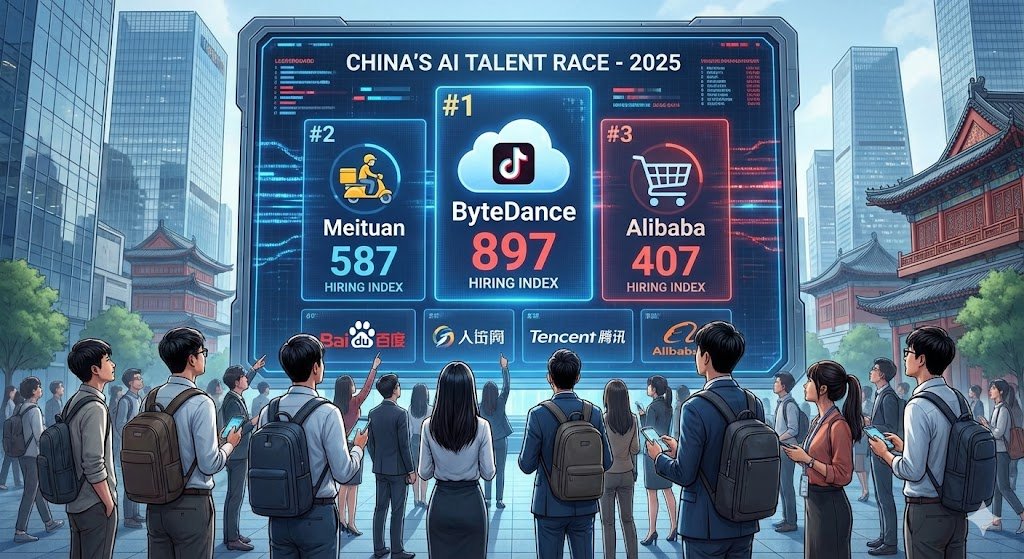
ByteDance, the company behind TikTok, has emerged as China’s most aggressive tech recruiter through the first ten months of 2025, according to data from Maimai, a professional networking platform often described as China’s LinkedIn. With a hiring index of 897, ByteDance is outpacing food delivery giant Meituan (587) and e-commerce behemoth Alibaba (407) by substantial margins.
But the ByteDance story is just the headline. The real story is what’s happening across China’s entire tech ecosystem—and what it signals about where AI development is headed globally.
The Numbers That Matter
AI-related job postings across China surged 543% year-over-year from January to October 2025. Let that number sink in. Not 54%. Not 154%. A more than five-fold increase in AI hiring demand in a single year.
While Maimai didn’t disclose absolute posting numbers, the growth rate alone reveals an industry in hyperdrive. This isn’t incremental expansion—it’s the kind of explosive hiring that happens when companies believe they’re in a winner-take-all race.
The salary data reinforces this urgency. Average monthly compensation for AI roles hit 61,764 yuan (approximately $8,800), running 36% higher than the broader new-economy sector average of 45,553 yuan ($6,464). Companies aren’t just hiring—they’re paying premium wages to secure scarce talent.
In a market as price-sensitive as China’s tech sector, that premium signals something important: AI talent has become a strategic constraint, and companies are willing to pay significantly above market rates to acquire it.
Beyond ByteDance: The Unexpected Players
While ByteDance’s dominance makes intuitive sense—TikTok’s recommendation engine is one of the world’s most sophisticated AI systems—some of the fastest-growing hirers reveal where China’s AI ecosystem is expanding.
Dreame, a smart hardware company specializing in robotic vacuums and cleaning devices, saw the fastest rise in new job postings. This might seem surprising until you consider what it represents: AI moving from cloud-based services into physical products that operate autonomously in people’s homes.
iFlyTek, a leader in voice recognition and natural language processing, ranked second in posting growth. Their focus on speech AI and education technology suggests continued investment in localized language models and specialized applications.
Amap, Alibaba’s mapping service, rounded out the top three. Their hiring surge likely reflects the intersection of AI with autonomous vehicles, logistics optimization, and location-based services—all areas where China is making significant infrastructure investments.
Meanwhile, smartphone makers Oppo and Transsion Holdings, along with drone manufacturer DJI, all doubled their job listings during the period. This pattern reveals something crucial: AI capabilities are increasingly seen as essential differentiators in hardware, not just software.
What ByteDance’s Lead Actually Means
ByteDance’s position at the top of both overall tech hiring and AI-specific recruitment isn’t accidental. The company has been methodically building AI capabilities across its product portfolio, far beyond TikTok’s famous recommendation algorithm.
Their AI investments span:
- Content recommendation and personalization engines
- Automated content moderation at scale
- Generative AI for content creation tools
- Large language models (they’ve developed their own foundational models)
- Computer vision for video understanding and effects
- Speech recognition and synthesis
This breadth explains the aggressive hiring. ByteDance isn’t optimizing a single AI application—they’re building comprehensive AI infrastructure that touches nearly every aspect of how billions of users create, discover, and interact with content.
The company’s hiring index of 897 suggests they’re not just maintaining their lead but actively expanding it. In the high-stakes game of AI development, that kind of sustained investment signals long-term strategic positioning rather than tactical response to competitors.
The Geographic and Strategic Context
China’s AI hiring surge is happening against a complex geopolitical backdrop. US export controls on advanced chips have created pressure to develop AI capabilities using available hardware or to optimize models more efficiently.
This constraint may actually be driving innovation. When you can’t simply throw more compute power at problems, you’re forced to be more creative about model architecture, training efficiency, and deployment optimization. The hiring surge suggests Chinese companies are doubling down on AI talent to navigate these technical challenges.
There’s also a domestic competitive dynamic at play. With WeChat’s ecosystem dominance in social and payments, and Alibaba’s e-commerce leadership under pressure from upstarts like PDD Holdings, AI capabilities are increasingly viewed as the path to competitive differentiation.
ByteDance’s TikTok demonstrated that superior recommendation algorithms could challenge established players. Every other Chinese tech company learned that lesson. The hiring race reflects an industry consensus: whoever builds the best AI fastest wins the next decade.
What Western Companies Should Notice
For global business leaders, China’s AI hiring surge offers several important signals:
The talent war is genuinely global. When average AI salaries in China reach $8,800 monthly—over $105,000 annually—Chinese companies are competing on compensation in ways that were less common even five years ago. The days of viewing China primarily as a low-cost development center are definitively over.
AI is moving into hardware faster than many anticipated. The fact that companies like Dreame, Oppo, and DJI are dramatically expanding AI hiring suggests the physical-digital integration is accelerating. Western hardware companies should be asking whether their AI capabilities match the ambition of these Chinese competitors.
Application diversity is expanding rapidly. The range of companies hiring—from social media to food delivery to mapping to smart home devices—shows that AI is becoming foundational infrastructure across sectors, not just a feature in tech giants’ products.
China isn’t waiting for Western AI models. While much Western commentary focuses on whether Chinese companies can access GPT-4 or Claude, the hiring data tells a different story: Chinese companies are building their own AI capabilities from the ground up, often optimized for Chinese language, culture, and use cases in ways foreign models may never match.
The Risks of This Arms Race
Explosive hiring growth sounds positive, but it creates its own challenges:
Talent dilution: When hiring grows 543% in a year, not every hire is a seasoned AI researcher. Companies may be bringing in people who need significant training and mentorship—stretching experienced teams thin.
Cost pressure: Premium salaries are sustainable when venture capital is flowing freely. If funding tightens, companies carrying large AI teams at above-market wages face difficult decisions.
Execution gaps: Hiring quickly doesn’t automatically translate to shipping successfully. Integrating hundreds or thousands of new AI engineers into productive teams takes time, process, and cultural intentionality.
Bubble risk: Any time an industry shows this kind of explosive growth, the possibility of a correction exists. Not every company hiring aggressively for AI will find profitable applications that justify the investment.
What This Means for Your AI Strategy
If you’re leading technology initiatives or AI adoption at a global company, China’s hiring surge raises questions you should be asking:
How does your AI talent acquisition compare? Are you competing effectively for AI expertise, or are you losing ground to companies—Chinese and Western—that are treating AI hiring as a strategic priority?
Is your AI investment matching the market pace? The 543% growth in Chinese AI job postings suggests a level of commitment to AI that goes beyond pilot projects and experiments. Are your AI initiatives at similar scale?
Where are you seeing AI-hardware integration opportunities? If Chinese hardware companies are dramatically expanding AI capabilities, what opportunities exist in your product lines to integrate intelligence at the device level?
Are you developing AI capabilities or just buying them? The hiring data suggests Chinese companies are building in-house AI expertise rather than primarily licensing external models. What’s the right build-versus-buy balance for your organization?
The Bottom Line
ByteDance’s position atop China’s tech hiring charts isn’t just about one company’s aggressive growth—it’s a signal of where the entire Chinese tech ecosystem is placing its bets.
The 543% surge in AI job postings represents a collective judgment by China’s most sophisticated technology companies: AI capabilities will determine competitive positioning across virtually every tech sector in the coming years. They’re backing that judgment with premium wages and massive hiring volume.
For Western companies and leaders watching from afar, this isn’t a threat to be feared or a trend to dismiss. It’s a competitive reality to understand and respond to strategically. The AI race isn’t just happening in Silicon Valley and Seattle—it’s happening simultaneously across multiple geographies, with different constraints, advantages, and approaches.
The companies that win won’t be those with the best research papers or the flashiest demos. They’ll be the ones that effectively translate AI capabilities into products people use, at scale, profitably. And right now, Chinese tech companies are making a massive bet on hiring their way to that outcome.
Whether that bet pays off remains to be seen. But one thing is certain: they’re not waiting to find out.
How is your organization thinking about AI talent acquisition in a global context? Are you seeing similar hiring pressures in your market? Share your experience in the comments.
