

AI isn’t coming—it’s already here. But if you think the transformation has been dramatic so far, 2026 is poised to make everything we’ve seen look like a dress rehearsal.
The difference? Two converging forces are about to democratize AI in ways that fundamentally reshape how businesses build, deploy, and measure technology: AI agents and AI-fueled coding. Together, these technologies are putting world-class AI capabilities into more hands than ever before—and the implications stretch far beyond the IT department.
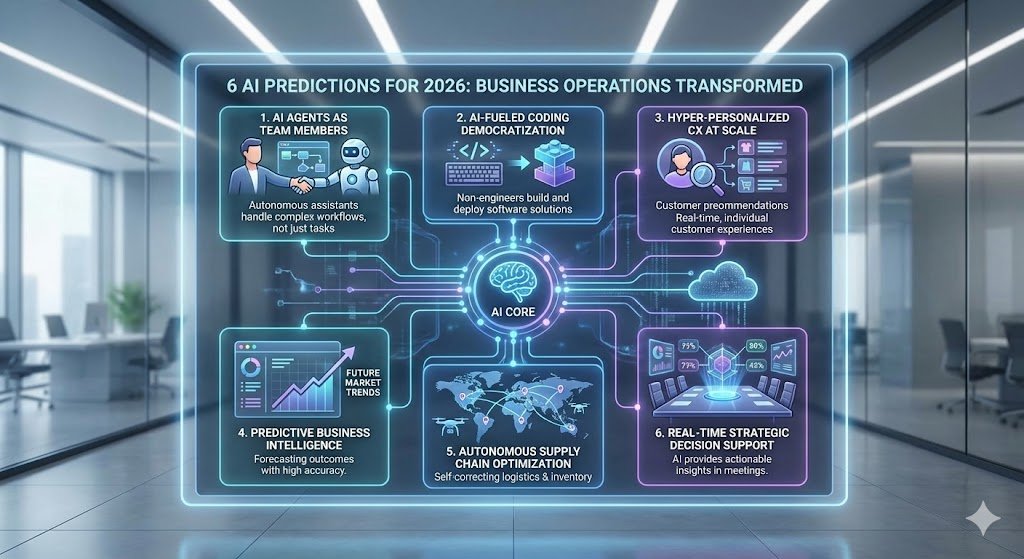
Here are six predictions for how AI will transform business operations in 2026, based on patterns emerging from companies already living in this future.
1. Fine-Tuned Small Language Models Will Dominate Enterprise AI
For years, conventional wisdom held that bigger AI models meant better results. That equation is rapidly changing.
Fine-tuned small language models (SLMs) are purpose-built for specific tasks and trained on focused datasets, delivering high accuracy for specialized functions. They’re breaking the old project management triangle that says you can only choose two of three: good, cheap, or fast.
These SLMs deliver all three.
Compared to their large language model counterparts, fine-tuned SLMs often perform comparably on accuracy while dramatically outperforming on speed and cost. This isn’t theoretical—businesses are already shifting their architectures to take advantage.
Here’s how it typically works: large language and reasoning models handle master control in agentic workflows, orchestrating overall strategy and complex decision-making. But when it comes to executing specific tasks within that workflow, purpose-built SLMs deliver the required accuracy and efficiency at a fraction of the computational cost.
The strategic implication? Businesses are waking up to the importance of their proprietary data in driving AI value. Generic models trained on the internet can only take you so far. Fine-tuned SLMs that learn from your data, yourprocesses, and your domain expertise are becoming the key to unlocking competitive advantage in mature AI implementations.
Expect to see a significant shift in enterprise AI spending from general-purpose model subscriptions toward custom SLM development and deployment in 2026.
2. AI-Fueled Coding Will Collapse Development Timelines to Minutes
AI coding assistants have been helping developers for years—autocompleting functions, generating boilerplate code, catching bugs. What’s coming in 2026 is fundamentally different in scope and impact.
AI-fueled coding represents the next evolution of agile methodology, tangibly redefining the entire software development lifecycle. We’re talking about shortening development timelines by orders of magnitude, increasing production-grade output, and enabling teams to focus on higher-level problem-solving rather than implementation details.
The transformation goes beyond faster coding. Developers start wearing multiple hats simultaneously—product owner, architect, engineer—dramatically reducing cycle times and time to operation. In the best cases, complete products or applications can be built in essentially one shot with minimal human editing required.
The proof points are already emerging. Some teams are building internal data products in 20 minutes that would have previously required six weeks. Critically, these aren’t just functional prototypes—they’re production-grade code that adheres to rigorous standards for quality, security, and compliance.
But here’s where it gets really interesting: non-technical teams can now participate in development. Using plain-language prompts, business users can build software prototypes that AI-fueled coding then transforms into full products with production-grade code—within hours instead of weeks.
This democratization of development capabilities will fundamentally alter who can solve problems with software and how quickly organizations can respond to emerging needs.
3. On-Demand Apps Will Replace Long-Term Software Investments
Most business applications have historically followed a predictable pattern: long development cycles, continued investment, constant maintenance, and deep organizational dependency. AI-fueled coding is about to disrupt that entire model.
When you can dramatically accelerate development cycles, a new possibility emerges: on-demand applications built to address immediate needs rather than anticipated future requirements.
Add autonomous agents into the mix—systems that can independently adapt to new requirements—and redevelopment becomes faster than traditional app maintenance cycles. Businesses can respond more quickly to changing needs, experiment with new solutions at lower cost, and pivot away from legacy apps that require long-term investment.
To be clear, traditional applications won’t completely disappear in 2026. Enterprise systems with complex integrations, regulatory requirements, and established user bases will persist. But the ability to launch and iterate on-demand functionality in a fraction of the time, leveraging agentic AI, creates a more agile and cost-effective option for many business challenges.
The strategic shift: Rather than investing heavily in applications designed to last five years, organizations will increasingly build lighter-weight solutions optimized for current needs, knowing they can rebuild or replace them quickly as requirements evolve.
This fundamentally changes the calculus around software ROI and technology debt.
4. Private Fiber Networks Will Connect Enterprises to Consolidated Compute Centers
Here’s a reality that often gets overlooked in AI discussions: computing relies on connectivity. With AI, complex computing needs to be faster than ever before.
Companies have spent the past few years re-evaluating cloud strategies to maximize AI value. In 2026, they’ll turn serious attention to the connectivity layer underneath those strategies.
Expect to see increased investment in private high-speed fiber networks built specifically for major enterprises investing heavily in AI. These dedicated pathways will connect businesses to cloud and compute centers with the fastest connectivity speeds available, without competing for bandwidth on public networks.
As these private networks proliferate, cloud providers will respond by consolidating data centers closer to where those networks terminate. We’re likely to see cloud infrastructure move closer to enterprise premises, ushering in a new era of cloud, hybrid-cloud, and on-premises networking that looks meaningfully different from today’s architecture.
Why does this matter? Latency becomes increasingly critical as AI applications become more real-time and interactive. A few milliseconds of delay might be imperceptible in traditional applications but can meaningfully degrade the user experience in AI-powered interfaces making split-second decisions.
Organizations serious about AI will increasingly treat connectivity as a strategic advantage rather than a commodity utility.
5. Telecom Companies Will Expand Into AI Services
Few industries manage data at the scale of telecommunications. That positioning, combined with deep expertise in training models and partnerships with major cloud and AI providers, creates a natural expansion opportunity.
In 2026, expect to see telecom companies offering productized AI services beyond their traditional role as connectivity providers. Services like model fine-tuning, secure data processing, and specialized AI infrastructure are logical extensions of existing capabilities.
Telecom companies have already mastered fine-tuning models on network data and have long track records in managing, processing, and securing massive datasets. They understand latency requirements, have direct relationships with enterprise customers, and control critical infrastructure that AI depends on.
By helping business customers tailor AI solutions to their specific needs, telecom providers can open new revenue streams while expanding their already essential role in the AI-powered business landscape.
This isn’t speculation—the foundation and market demand are already visible. What’s coming in 2026 is the productization and scaling of services that pioneering telecom companies are already testing internally.
6. Speed, Accuracy, and Cost Will Become Universal AI Metrics
As AI shifts from novelty to necessity across every industry and department, a critical maturation is happening: the establishment of standard metrics for measuring AI performance.
It’s no longer enough to simply use AI tools. Organizations need to use them well, with measurable results that justify investment and guide optimization.
Three metrics are emerging as the universal language of AI performance:
Speed: How quickly can the AI system generate results or complete tasks? In customer-facing applications, speed directly impacts user experience. In internal workflows, it determines productivity gains.
Accuracy: How reliable and correct are the AI outputs? This is ultimately what drives value. An AI system that’s fast and cheap but frequently wrong creates more problems than it solves.
Cost: What’s the total cost of ownership for running AI systems at scale? This includes compute costs, development expenses, maintenance overhead, and the human effort required to review and correct outputs.
Every organization and every department—from marketing to human resources to finance—will start tracking return on investment, reliability, and scalability for their AI tools using these foundational metrics.
This shift represents AI’s evolution from experimental technology to standard business infrastructure. Just as organizations track website load times, error rates, and hosting costs, they’ll track AI performance metrics with the same rigor and expectation of continuous improvement.
AI will become the common denominator and shared language across the entire business world—not because everyone becomes a data scientist, but because everyone becomes fluent in evaluating AI performance using consistent, meaningful metrics.
What This Means for Your Strategy
These predictions aren’t about distant possibilities—they’re about trends already in motion that will accelerate dramatically in 2026. The strategic questions for business leaders are:
Are you investing in small language models tailored to your data? If you’re only using general-purpose LLMs, you’re likely overpaying and underperforming on specialized tasks.
Have you experimented with AI-fueled coding? Even if your organization isn’t ready to fully embrace this methodology, understanding its potential impact on development timelines should inform your technology roadmap and competitive positioning.
Are you treating apps as disposable or permanent? Your answer to this question will determine whether you’re positioned to take advantage of on-demand application development or locked into legacy investment patterns.
How’s your connectivity infrastructure? If you’re planning significant AI investments, your network architecture may be the bottleneck you haven’t considered yet.
What are your AI performance metrics? If you can’t measure speed, accuracy, and cost for your AI systems, you can’t optimize them—and you’re flying blind on ROI.
The Bottom Line
Nothing in technology is written in stone, and it’s entirely possible that something unexpected could emerge and change these trajectories. But these predictions aren’t based on speculation—they’re based on patterns visible in organizations already operating at the leading edge of AI adoption.
The democratization of AI through agents and coding tools is real. The shift from general models to specialized SLMs is happening. The infrastructure to support AI at scale is being built. And the metrics to measure AI value are crystallizing.
2026 won’t be the year AI arrives—it already has. It will be the year AI becomes standard operating procedure across industries, departments, and functions. The organizations preparing for that reality now will be the ones defining what competitive advantage looks like in an AI-powered business landscape.
The future isn’t waiting. Are you building for it?
Which of these predictions resonates most with your organization’s AI strategy? What are you seeing that we might have missed? Share your perspective in the comments.
