

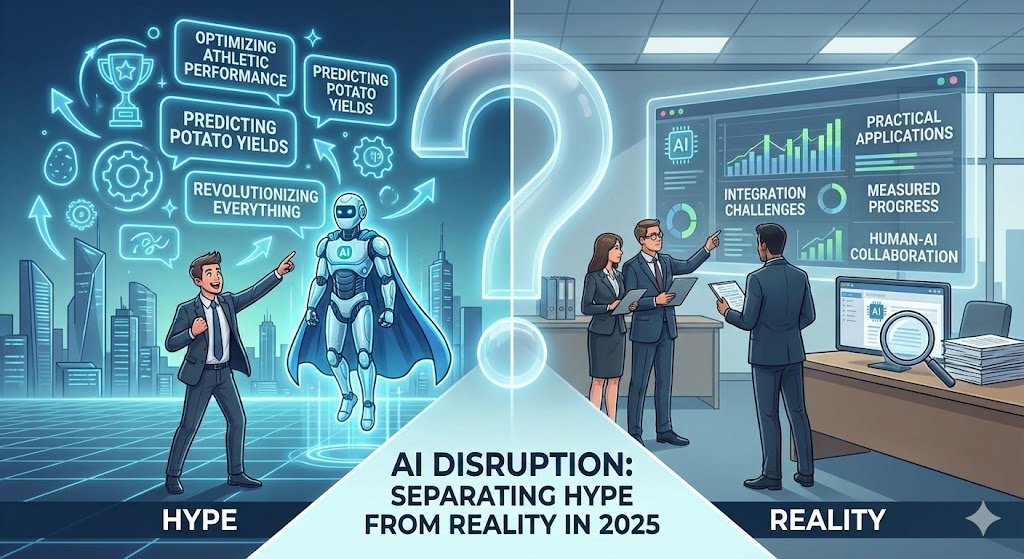
If you’ve been anywhere near the business news cycle lately, you’ve probably noticed a pattern: AI is apparently revolutionizing everything. From optimizing athletic performance to predicting potato yields, artificial intelligence has become the go-to explanation for how industries are being transformed.
But here’s the uncomfortable question that doesn’t make for great headlines: Is AI actually disrupting industries, or have we just decided it’s the only disruption worth talking about?
The answer, unsurprisingly, is more complicated than either the breathless evangelists or the cynical skeptics would have you believe.
The AI Disruption Echo Chamber
There’s no denying that artificial intelligence is having a real impact across sectors. Machine learning algorithms are improving diagnostic accuracy in healthcare, generative AI is accelerating content creation workflows, and predictive models are making supply chains more efficient.
But somewhere between “AI is doing interesting things” and “AI is revolutionizing everything,” we’ve lost the plot.
The current discourse creates a kind of selection bias where every industry transformation gets filtered through an AI lens, whether or not AI is the primary driver. A company implements better data analytics? That’s AI disruption. A business automates a manual process? AI revolution. Someone uses ChatGPT to draft an email? Game-changing AI transformation.
This reframing isn’t just semantic. It shapes how businesses allocate resources, how investors place bets, and how leaders prioritize strategic initiatives. And it risks obscuring other forms of innovation that might be just as impactful—or more so—for specific industries and contexts.
What Real Disruption Actually Looks Like
Let’s get grounded in what genuine industry disruption means. Clayton Christensen’s classic framework describes disruption as occurring when new entrants serve overlooked segments with simpler, more affordable solutions that eventually overtake established players.
By that definition, some of the most significant disruptions of the past decade had little to do with AI:
Dollar Shave Club disrupted Gillette not with artificial intelligence but with a direct-to-consumer model and irreverent marketing that challenged assumptions about how men buy razors.
Airbnb transformed hospitality primarily through a peer-to-peer marketplace model and trust-building mechanisms, not through AI algorithms (though they certainly use them now).
Tesla disrupted automotive not just with electric powertrains but with a fundamentally different go-to-market strategy, over-the-air updates, and vertical integration that legacy manufacturers couldn’t match.
Were these companies sophisticated users of technology, including AI in many cases? Absolutely. But the disruptive force came from rethinking business models, customer experiences, and value propositions—not from AI alone.
The Industries Where AI Is (and Isn’t) the Story
So where is AI genuinely driving transformation versus where it’s just a supporting character in a larger narrative?
Where AI Is Leading Disruption
Drug Discovery: AI is fundamentally changing the economics and timelines of pharmaceutical development. Companies like Recursion and Insilico Medicine are using AI to identify drug candidates in months rather than years, potentially compressing development cycles that traditionally took over a decade.
Financial Fraud Detection: Real-time AI models are catching fraudulent transactions with a speed and accuracy that rule-based systems never could, saving financial institutions billions while improving customer experience.
Personalized Education: Adaptive learning platforms powered by AI are genuinely personalizing education at scale in ways that were previously only possible with expensive one-on-one tutoring.
Where AI Is a Supporting Player
Retail Transformation: Yes, retailers use AI for inventory optimization and personalized recommendations. But the real disruption came from e-commerce infrastructure, logistics networks, and changing consumer expectations around convenience—most of which predated modern AI.
Remote Work Revolution: AI tools are making distributed teams more productive, but the fundamental disruption to work came from cultural shifts, video conferencing infrastructure, and cloud collaboration platforms.
Sustainable Energy: While AI helps optimize grid management and predict equipment failures, the disruption in energy is being driven by dramatic cost reductions in solar and battery technology, policy changes, and infrastructure investment.
The Hidden Cost of AI Tunnel Vision
When business leaders view every strategic challenge through an AI lens, they risk making several costly mistakes:
Overlooking simpler solutions. Sometimes the innovation your business needs isn’t a sophisticated AI model—it’s a clearer value proposition, a more efficient process, or better customer service. AI can’t fix a fundamentally flawed business model.
Misallocating resources. The pressure to “do something with AI” can lead organizations to invest in flashy AI initiatives while underfunding the operational improvements, talent development, or market research that would actually move the needle.
Missing adjacent innovations. While everyone’s focused on AI, other technological and non-technological innovations are creating opportunities. Blockchain applications in supply chain transparency, advances in materials science, innovative financing models, and new regulatory frameworks are all reshaping industries—often with minimal AI involvement.
Creating implementation gaps. Many organizations are discovering that their AI initiatives fail not because the technology doesn’t work but because they lack the data infrastructure, change management capabilities, or clear use cases to make AI effective. The bottleneck isn’t AI—it’s organizational readiness.
A More Nuanced View of Innovation
So what’s a more realistic way to think about AI’s role in industry transformation?
Think of AI as an enabler rather than a disruptor in itself. AI makes certain business models viable that weren’t before. It accelerates processes that were already valuable. It scales personalization that was previously cost-prohibitive.
But enablement isn’t the same as disruption. The most successful “AI disruptions” combine the technology with:
- Novel business models that challenge industry assumptions
- Exceptional user experiences that create new customer expectations
- Operational excellence that delivers consistent value
- Strategic positioning that exploits incumbent weaknesses
- Organizational culture that can execute on vision
Consider Netflix. Yes, they use sophisticated AI for content recommendations. But their disruption of entertainment came from subscription models, original content strategies, data-driven commissioning, and a willingness to cannibalize their own DVD business. AI was part of the story, not the whole story.
What This Means for Your Strategy
If you’re a business leader trying to navigate the AI hype cycle, here are some practical principles:
Start with the problem, not the technology. What customer needs are you failing to meet? What operational inefficiencies are costing you? What competitive threats are emerging? Only after defining these challenges should you ask whether AI is the right solution.
Diversify your innovation portfolio. By all means, explore AI applications where they make sense. But also invest in business model innovation, customer experience improvements, process optimization, and talent development. The healthiest innovation pipelines include multiple paths to value creation.
Watch for non-AI disruptions. Keep your eyes open for emerging competitors who are succeeding through superior service, innovative pricing, community building, or fundamentally different value propositions. These threats can be just as existential as AI-powered competitors—sometimes more so.
Build AI literacy without AI obsession. Your team should understand what AI can and cannot do. But they should be equally literate in design thinking, lean operations, agile methodology, and other frameworks for driving change. AI is one tool in a larger toolkit.
Measure outcomes, not AI adoption. Don’t track how many AI models you’ve deployed. Track whether you’re improving customer satisfaction, reducing costs, accelerating time-to-market, or achieving whatever outcomes actually matter to your business. If AI helps you get there, great. If something else works better, that’s great too.
The Bottom Line
Is AI disrupting industries? Yes, in specific contexts where it enables fundamentally new capabilities or economics.
Is AI the only way to disrupt industries? Absolutely not.
Is every headline about AI disruption accurate? Not even close.
The most dangerous thing business leaders can do right now isn’t ignoring AI—it’s assuming that AI is the answer to every strategic question. The companies that will truly disrupt their industries in the years ahead will be those that combine AI capabilities with creative thinking about business models, relentless focus on customer value, and the wisdom to recognize when the best innovation has nothing to do with artificial intelligence at all.
Sometimes the most disruptive thing you can do is solve a real problem in a straightforward way. And if that happens to involve AI, well, that’s just a bonus.
How is your organization thinking about AI versus other forms of innovation? Are you finding the right balance, or has AI hype skewed your strategic priorities? Let’s discuss in the comments.
