

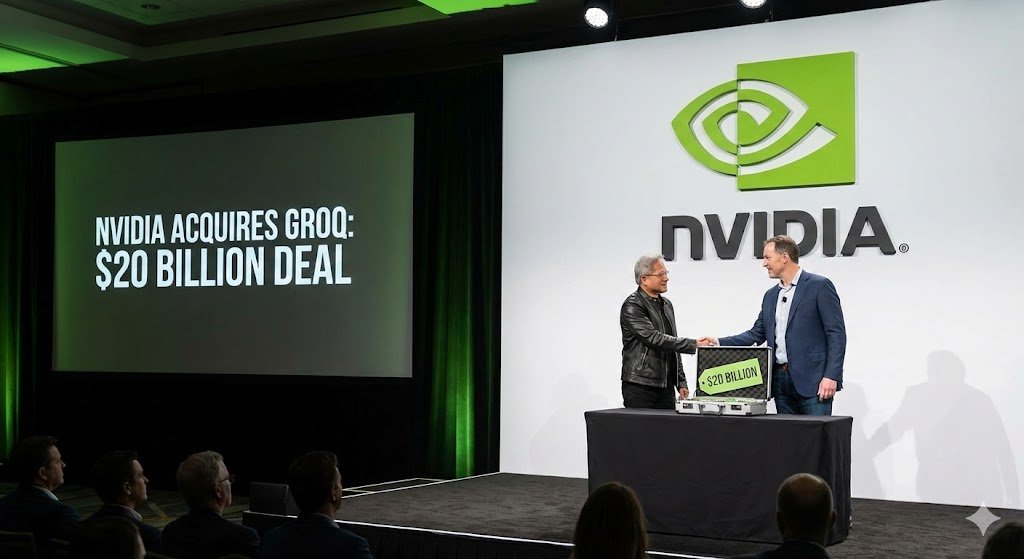
The AI chip giant is buying the startup that was supposed to challenge its dominance. Welcome to the age of consolidation, where the best way to beat the competition is to acquire it.
By Shafaq | Jan 01, 2026
In a move that perfectly encapsulates the current AI hardware landscape, Nvidia announced it’s acquiring assets from AI chip startup Groq for approximately $20 billion in cash — the company’s largest-ever acquisition. The deal includes a non-exclusive licensing agreement for Groq’s technology and the recruitment of key executives and engineers who’ve been building some of the most credible competition Nvidia has faced in years.
Let’s be clear about what just happened: Nvidia, which already controls an estimated 80-90% of the AI training chip market and holds a market capitalization exceeding $3 trillion, just eliminated one of the few startups that had a legitimate shot at disrupting its dominance in AI inference workloads.
And before anyone gets confused — this is Groq the chipmaker, not Grok the AI chatbot from Elon Musk’s xAI. Yes, the similar names have caused exactly the confusion you’d expect on social media. No, they’re not related.
What Groq actually built
Founded in 2016 by former Google engineers, Groq specialized in something Nvidia has historically dominated but faces growing competition in: AI inference chips. These are the processors that deliver rapid responses from already-trained AI models — the hardware running when you ask ChatGPT a question, when a hospital system analyzes medical images, or when a financial firm processes fraud detection in real-time.
Groq’s value proposition was compelling: high-speed, energy-efficient inference that could challenge Nvidia’s GPUs on both performance and power consumption. The company had raised around $1 billion from investors and secured partnerships with major cloud providers, positioning itself as one of the most serious challengers to Nvidia’s inference dominance.
The keyword in that sentence is “had.”
Why Nvidia is paying $20 billion
At first glance, $20 billion seems like a staggering amount for a startup that was still building market share. But consider Nvidia’s position: the company’s data center revenues are booming as enterprises pile into AI infrastructure, and inference workloads represent an increasingly critical — and lucrative — segment as generative AI applications scale.
By acquiring Groq, Nvidia accomplishes several things simultaneously:
Eliminates a credible competitor before it can gain serious traction in cloud deployments and enterprise contracts.
Acquires cutting-edge technology that Nvidia can integrate into its future product roadmap, complementing its existing leadership in AI training chips.
Absorbs talent — the former Google engineers and other specialists who understand inference optimization at a level that took years to develop.
Sends a signal to the market that Nvidia isn’t content to rest on its GPU dominance and will aggressively consolidate technologies that could threaten its position.
The deal also comes with a non-exclusive licensing agreement for Groq’s technology, which suggests Nvidia might allow limited ecosystem partnerships while keeping the core innovations under its control.
The consolidation playbook
This acquisition follows a familiar pattern in the tech industry: when a dominant player faces a credible challenger, the easiest path forward is often to just buy them. It’s cheaper than fighting a prolonged competitive battle, faster than developing equivalent technology in-house, and eliminates uncertainty about future market dynamics.
For Groq’s investors, a $20 billion exit on roughly $1 billion raised is an excellent outcome. For Nvidia, $20 billion is meaningful but manageable given the company’s market cap and revenue trajectory. For the broader AI hardware ecosystem? It’s one less independent option for companies trying to avoid total dependence on Nvidia’s chips.
The regulatory question
The deal comes amid “intensifying competition and regulatory scrutiny,” as the announcement delicately phrased it. And that’s putting it mildly. Nvidia already faces antitrust concerns in multiple jurisdictions over its market dominance. Acquiring one of the few startups that could potentially challenge that dominance seems likely to attract regulatory attention.
The question is whether regulators will view this as anti-competitive consolidation or as a natural evolution in a rapidly developing market where scale and integration matter. Nvidia will almost certainly argue that the AI chip market remains competitive, with players like AMD, Intel, and various startups continuing to develop alternative solutions.
Critics will counter that allowing Nvidia to acquire its most promising inference competitor further entrenches monopoly dynamics in a critical technology sector.
Meanwhile, in the other Grok universe…
In completely unrelated news that will absolutely continue to confuse people searching for information about this deal: Elon Musk’s xAI launched Grokipedia in October 2025, an AI-generated encyclopedia built using the Grok language model.
Musk has described the project as creating the “largest and most truthful” knowledge base by combining AI-generated content with crowdsourced inputs. He’s also used it as an opportunity to criticize what he perceives as bias in Wikipedia, because of course he has.
But again: Grokipedia (Musk’s project) has nothing to do with Groq (the chip company Nvidia just acquired). The only connection is that both names will now forever be linked in search results and confused by people who don’t closely follow the AI industry.
What this means for the AI hardware market
Nvidia’s acquisition of Groq is the clearest signal yet that the AI chip market is entering a consolidation phase. After years of startups raising billions to challenge Nvidia’s dominance, the calculus is shifting: it’s becoming harder to compete independently, and the exit valuations for acquisition are attractive enough that investors and founders are willing to sell.
For enterprises building AI infrastructure, the message is less encouraging: your options for avoiding Nvidia dependence just narrowed. Yes, AMD and Intel are still competing. Yes, Google has its TPUs and Amazon has its custom chips for internal use. But the independent startup ecosystem that was supposed to inject competition into the market is getting absorbed.
For Nvidia, the deal represents strategic offense disguised as defense. The company doesn’t need Groq’s technology to survive — it’s already winning. But acquiring Groq ensures that margin pressures from inference competition remain manageable while giving Nvidia additional tools to maintain its lead as the market evolves.
The $20 billion question
Was Groq worth $20 billion? In a vacuum, probably not. In the context of Nvidia protecting a multi-trillion-dollar market position in the most important technology sector of the decade? Absolutely.
The acquisition is a reminder that in emerging technology markets, the window for independent challengers to scale before getting acquired is narrower than the venture capital pitch decks suggest. And for companies like Nvidia with the capital, market position, and strategic foresight to consolidate aggressively, buying the competition before it becomes a real threat is just good business.
Whether it’s good for the industry, innovation, or customers who might have benefited from more competition in AI inference chips? That’s a different question entirely.
For now, the takeaway is simple: Nvidia just spent $20 billion to make sure one of its most credible challengers becomes part of the family instead of the competition.
And in Silicon Valley, that’s what winning looks like.
