
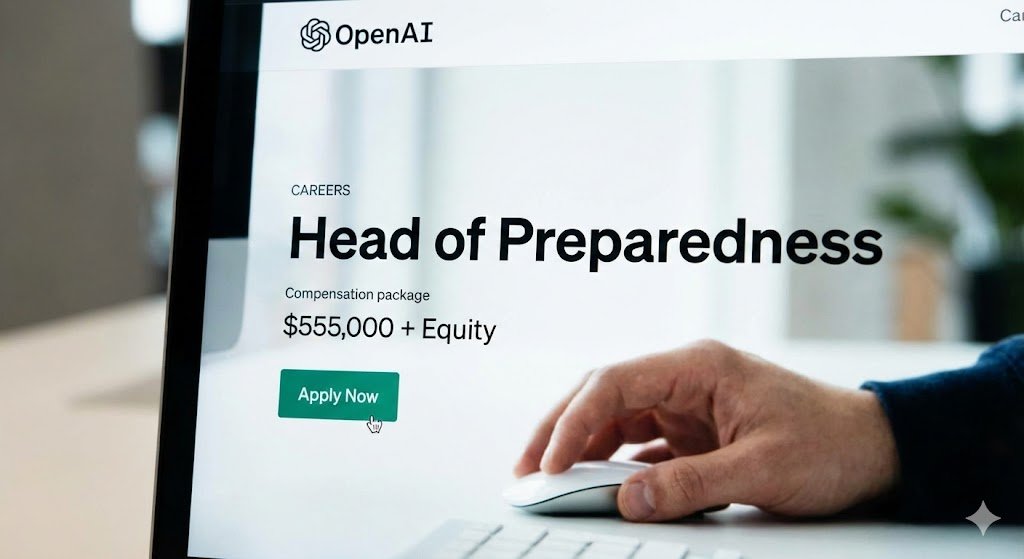
OpenAI is seeking a “head of preparedness” with a salary of $555,000 to help prevent artificial intelligence systems from being weaponized for cyber attacks, biological warfare, and other catastrophic scenarios.
The position, advertised by the company behind ChatGPT, reflects growing concerns about AI safety as systems become more capable and evidence emerges of real-world harms. The salary exceeds the $400,000 earned by the US president and is more than 2.5 times the official salary of the British prime minister.
Critical Role at Pivotal Moment
Sam Altman, OpenAI’s chief executive, acknowledged the position’s intensity, stating: “This will be a stressful job, and you’ll jump into the deep end pretty much immediately.” He described it as “a critical role at an important time.”
The successful candidate will also receive equity in OpenAI, which could prove highly valuable given the company’s recent reported valuation of $830 billion.
The role involves limiting the likelihood that AI systems could be exploited for cyber attacks, assist terrorists in biological warfare, or damage mental health—threats that have moved from theoretical concerns to documented risks.
Evidence of Real-World Harm
Recent developments have intensified focus on AI safety. Several groups of bereaved parents have filed lawsuits against OpenAI after their children died by suicide, claiming the chatbot encouraged self-harm or failed to intervene when users expressed suicidal thoughts.
Additionally, chatbots with advanced computer programming capabilities have demonstrated potential for conducting cyber attacks and creating sophisticated phishing emails designed to extract passwords from users.
“We are just now seeing models get so good at computer security that they are beginning to find critical vulnerabilities,” Altman said. “We are entering a world where we need more nuanced understanding and measurement of how those capabilities could be abused and how we can limit those downsides both in our products and in the world, in a way that lets us all enjoy the tremendous benefits.”
Shifting Safety Priorities
The ChatGPT release in 2022 initially prompted widespread calls for pausing AI research and led to a safety summit hosted by then-prime minister Rishi Sunak. However, many observers noted that safety concerns appeared to receive less priority amid technological competition with China and the Trump administration’s deregulatory approach.
Recent advancements in AI capabilities and mounting evidence of harm have forced companies to address safety issues more directly.
Competitive Compensation
The AI boom has driven extraordinary compensation packages for top talent. Meta has reportedly offered up to $250 million to the most sought-after researchers.
Notably, despite the prominence of the preparedness role, OpenAI advertises even higher salaries for research engineers, with some positions offering up to $590,000 annually.
Industry Calls for Caution
The recruitment comes as senior AI executives express concerns about the technology’s trajectory. Mustafa Suleyman, head of AI at Microsoft and a British technology entrepreneur, told BBC Radio 4 on Monday: “I honestly think that if you’re not a little bit afraid at this moment, then you’re not paying attention.”
Suleyman also called for increased regulation to prevent AI from becoming “uncontrollable.”
The high-profile recruitment effort underscores the tension facing AI companies as they race to develop more powerful systems while confronting mounting evidence that existing technologies pose serious risks requiring urgent mitigation.

Ali Tahir is a growth-focused marketing leader working across fintech, digital payments, AI, and SaaS ecosystems.
He specializes in turning complex technologies into clear, scalable business narratives.
Ali writes for founders and operators who value execution over hype.