
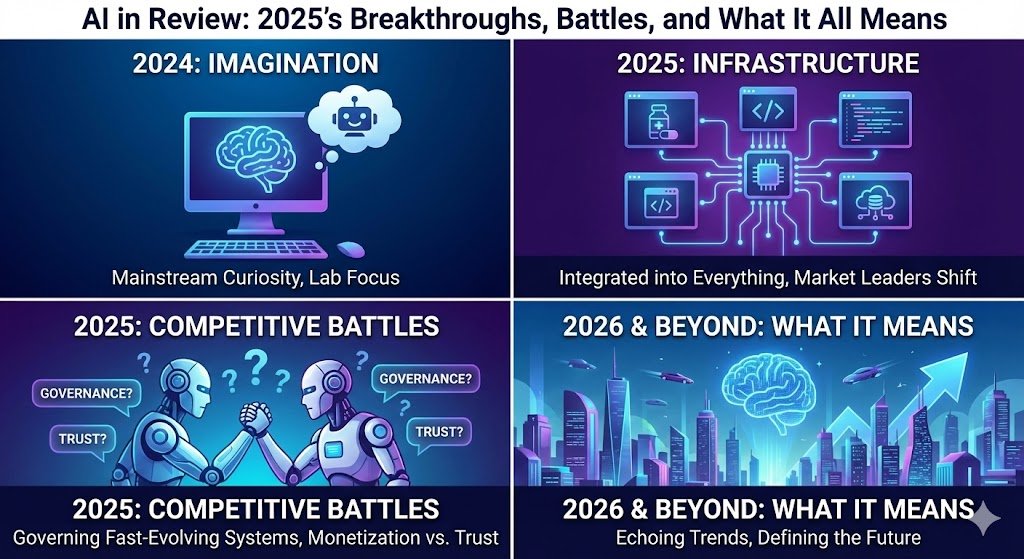
If 2024 was the year AI captured mainstream imagination, 2025 was the year it grew up—messier, more competitive, and infinitely more consequential.
The technology stopped being something fascinating happening in research labs and became infrastructure underpinning everything from drug discovery to software engineering. The market leaders changed. The geopolitical dynamics shifted. The capabilities leapt forward in ways that made last year’s breakthroughs feel quaint.
Most importantly, 2025 was the year organizations stopped asking “should we use AI?” and started asking much harder questions: “How do we govern systems that evolve faster than our policies? How do we compete when our rivals are hiring thousands of AI engineers? How do we build trust when monetization pressures conflict with user expectations?”
Here’s what defined AI in 2025—the breakthroughs that mattered, the competitive battles that reshaped the landscape, and the trends that will echo into 2026 and beyond.
The Model Wars Reached Peak Intensity
The arms race between leading AI labs accelerated to a pace that would have seemed impossible even 18 months ago. In November and December alone, we witnessed an unprecedented release cycle:
OpenAI’s GPT-5 launched in August as a unified system featuring state-of-the-art performance across coding, math, writing, health, and visual perception. The model introduced integrated reasoning capabilities that eliminated the need to switch between specialized models—a significant architectural evolution from the GPT-4 era.
By November, OpenAI released GPT-5.1, which was warmer and more conversational while maintaining advanced capabilities. Less than a month later, GPT-5.2 arrived as “the most capable model series yet for professional knowledge work,” with improvements in creating spreadsheets, building presentations, writing code, and understanding long contexts.
This release velocity—three major model updates in four months—reflects both OpenAI’s technical momentum and competitive pressure. The company declared a “code red” effort to improve ChatGPT and sideline other projects in response to Google’s advances.
Anthropic’s counter-offensive came in waves. Claude Opus 4.5, released in November, achieved 80.9% on SWE-bench Verified, a test of real-world software coding capabilities. More impressively, the model demonstrated the ability to autonomously refine its own capabilities, reaching peak performance in 4 iterations while other models required 10.
Google’s Gemini 3 entered the fray, showing significant leaps in reasoning, multimodality, and efficiency that transformed Google’s product portfolio from Pixel devices to Search. The competition became so intense that Salesforce CEO Marc Benioff publicly announced he was switching from ChatGPT to Gemini 3.
Meanwhile, China emerged as a genuine AI superpower. In January, Chinese firm Deepseek released its R1 model, which rocketed to second on the Artificial Analysis AI leaderboard despite being trained for a fraction of the cost of Western competitors, wiping half a trillion dollars off Nvidia’s market cap.
The implications of Deepseek’s efficiency breakthrough reverberated globally. If frontier AI performance didn’t require frontier budgets, the competitive dynamics changed fundamentally. China went from having no widely-known large language models in the West to becoming “a strong second in the AI race—and when it comes to open-source models, the leader”.
Reasoning Models Changed What AI Can Do
The most significant technical advancement of 2025 wasn’t just about bigger models—it was about models that think.
Reasoning models generate hundreds of words in a “chain of thought,” often obscured from the user, to come up with better answers to hard questions. Their impact was drastic: reasoning models from Google DeepMind and OpenAI won gold in the International Math Olympiad and derived new results in mathematics.
Most notably, Google DeepMind announced that their Gemini Pro reasoning model had helped speed up the training process behind Gemini Pro itself—modest gains, but precisely the sort of self-improvement that some worry could end up producing an artificial intelligence that we can no longer understand or control.
The practical applications extended far beyond academic achievements. GPT-5’s responses were ~80% less likely to contain a factual error when using reasoning compared to previous models. On SWE-bench, models improved from 4.4% to 71.7% accuracy—a 67 percentage point leap in roughly one year on tasks that required human software engineers just 12 months ago.
This wasn’t incremental improvement. It was a fundamental expansion of what AI systems could reliably accomplish.
AI-Fueled Coding Became Production Reality
Perhaps no domain saw more dramatic AI integration than software development. What started as autocomplete assistance evolved into systems capable of autonomous multi-step engineering work.
OpenAI released GPT-5.2-Codex as “the most advanced agentic coding model yet for complex, real-world software engineering,” with improvements on long-horizon work through context compaction, stronger performance on large code changes like refactors and migrations, and significantly stronger cybersecurity capabilities.
The cybersecurity implications were sobering. A security researcher using GPT-5.1-Codex-Max with Codex CLI found and responsibly disclosed a critical React vulnerability (CVE-2025-55182) that had escaped previous detection.
Anthropic’s Claude Opus 4.5 matched or exceeded these capabilities. When given the same take-home coding test Anthropic administers to prospective performance engineering candidates, Opus 4.5 scored higher than any human candidate ever had.
The economic implications became clear: development cycles that previously took weeks were collapsing to hours or minutes. One organization reported building an internal data product in 20 minutes that would have required six weeks without AI-fueled coding—and critically, the output met rigorous standards for quality, security, and compliance.
Science Accelerated by Orders of Magnitude
AI’s impact on scientific research moved from promising to transformative in 2025.
Making Alzheimer’s diagnoses faster and cheaper with AI became reality, as researchers at universities and healthcare institutions announced findings about how AI assists with future therapies and better detection in primary care. One study found that a specific gene is a cause of Alzheimer’s—a discovery researchers were only able to make because AI helped them visualize the three-dimensional structure of the protein.
University of Michigan researchers developed an AI model capable of diagnosing coronary microvascular dysfunction (CMVD), a notoriously difficult-to-detect form of heart disease, using only a standard 10-second EKG strip. In clinical tests, the AI system accurately identified the condition within seconds.
Weather forecasting became more powerful than ever thanks to AI, with researchers combining AI with physics-based climate models to predict extreme weather that may happen every 1,000 years, known as “gray swan” events. Google released its most advanced forecasting model, which can generate forecasts eight times faster than before.
GPT-5.2 Pro and GPT-5.2 Thinking emerged as “the world’s best models for assisting and accelerating scientists,” with improvements on benchmarks like FrontierMath reflecting “not a narrow skill, but stronger general reasoning and abstraction, capabilities that carry directly into scientific workflows such as coding, data analysis, and experimental design”.
The federal government recognized this potential. The U.S. invested $3.3 billion in non-defense AI research and development in fiscal year 2025.
Enterprise AI Shifted From Pilots to Production
The defining organizational trend of 2025 was the transition from experimentation to deployment at scale.
33% of organizations deployed agentic AI systems in production, gaining competitive advantages over slower-moving competitors. The average ChatGPT Enterprise user reported saving 40-60 minutes daily, with heavy users saving more than 10 hours weekly.
But scaling AI created new challenges. Cybersecurity concerns topped executive risk lists across organizations of all sizes, with AI-related risks becoming a primary worry specifically around data security and exposure.
The hiring response was dramatic. In China, AI-related job postings surged 543% year-over-year, with average monthly salaries for AI roles reaching 61,764 yuan ($8,800), running 36% higher than the broader new-economy sector average. ByteDance led with a hiring index of 897, outpacing Meituan at 587 and Alibaba at 407.
This wasn’t just tech giants hiring. Smart hardware firm Dreame, voice recognition leader iFlyTek, and mapping service Amap all saw explosive hiring growth, while smartphone makers Oppo and Transsion Holdings, along with drone manufacturer DJI, doubled their AI job listings.
Governance Struggled to Keep Pace
The gap between AI capabilities and effective governance frameworks widened throughout 2025.
Adaptive governance evolved from academic concept to practical necessity. Organizations building AI systems that changed weekly couldn’t rely on annual policy updates. Continuous oversight became standard, with policies evolving alongside model versioning and deployment cycles.
Privacy engineering shifted from compliance checkbox to competitive differentiator. Differential privacy, secure enclaves, and encrypted computation moved into mainstream toolkits as users became more sophisticated and regulators less forgiving.
AI supply chain audits became mandatory for mature organizations. Companies began mapping dependencies with forensic precision, evaluating whether training data was ethically sourced, whether third-party services complied with emerging standards, and whether model components introduced hidden vulnerabilities.
The autonomous agent problem created new accountability questions. When systems act independently, traditional oversight mechanisms don’t map cleanly. Organizations developed responsibility matrices to define liability in multi-agent ecosystems, asking not “did the system fail?” but “which component triggered the cascade?”
The Geopolitical Dimension Intensified
AI became a Great Power competition issue in ways that would have seemed dramatic even at the start of 2025.
On his first day back in the Oval Office, Trump revoked the wide-reaching Biden executive order that regulated AI development. On his second, he welcomed the CEOs of OpenAI, Oracle, and SoftBank to announce Project Stargate—a $500 billion commitment to build the data centers and power generation facilities needed to develop AI systems.
Trump expedited reviews for power plants, aiding data center construction but reducing air and water quality protections. He relaxed export restrictions on AI chips to China, which Nvidia CEO Jensen Huang said would help the chipmaker retain its world-dominant position, but observers noted it would give a leg up to the U.S.’s main competitor.
The regulatory approach shifted from “safe, secure and trustworthy development” to “winning the race,” with profound implications for both domestic policy and international competition.
The Business Model Crisis Came to a Head
Perhaps no issue crystallized AI’s maturation challenges more than monetization.
Reports emerged that OpenAI was exploring how to inject sponsored content into ChatGPT responses, with hypothetical examples including asking for ibuprofen dosage recommendations and receiving Advil advertisements.
The reaction was swift and negative. The concern wasn’t just about ads—it was about trust. When users pay subscription fees and rely on AI for medical advice, financial decisions, and professional work, sponsored content fundamentally changes the relationship.
The underlying problem: nobody has cracked sustainable AI economics. Training costs millions to billions. Inference remains expensive at scale. Competition intensifies while users resist price increases. In this environment, advertising looks like a necessary evil—proven, scalable, and capable of generating required revenue.
But if every AI assistant becomes ad-supported, they all become less trustworthy. Users will treat AI like they treat Google search—skeptical, verification-minded, always aware results might be manipulated. That fundamentally changes AI’s value proposition.
What 2025 Revealed About AI’s Future
Looking across these developments, several patterns emerge that will define 2026 and beyond:
The performance ceiling keeps rising, faster than predicted. The gap between what seemed impossible in early 2025 and what became routine by December compressed dramatically. Models that achieve human-expert performance on increasingly complex tasks suggest we’re still early in the capability curve.
Geopolitical competition is accelerating innovation while creating fragmentation. The U.S.-China AI race is driving unprecedented investment and talent mobilization, but also creating parallel ecosystems with different standards, approaches, and values embedded in foundational systems.
Enterprise adoption is outpacing governance. Organizations are deploying AI systems before fully understanding how to govern them, creating operational risks that will become more apparent as these systems handle increasingly consequential decisions.
The gap between leaders and followers is widening. Organizations that moved aggressively on AI in 2024-2025 are pulling ahead of slower-moving competitors in ways that may be difficult to reverse. The 543% hiring surge in China and similar patterns elsewhere suggest a winner-take-most dynamic emerging.
Trust will become the defining competitive factor. As technical capabilities converge across leading models, differentiation will increasingly come from trustworthiness—in privacy practices, governance frameworks, transparency, and alignment between commercial interests and user welfare.
Preparing for 2026
So what should organizations take from 2025’s developments?
The experimentation phase is over. If you’re still running pilots, you’re likely falling behind competitors who’ve moved to production deployment. The question isn’t whether to adopt AI but how to scale it responsibly.
Governance can’t wait for perfect policy. Build adaptive frameworks that evolve with your systems rather than waiting for regulatory clarity that may never arrive in time to matter.
Talent is the constraint. The hiring surge across geographies and industries reflects a genuine scarcity of AI expertise. Organizations that can’t compete on compensation need to compete on mission, learning opportunities, or other dimensions that attract talent.
Trust is infrastructure, not afterthought. Design privacy engineering, transparency mechanisms, and accountability frameworks into your AI systems from the start. These will become competitive differentiators as users become more sophisticated about AI risks.
Watch the capability curve, not just current applications. The pace of improvement in 2025 suggests planning for AI capabilities 12-24 months out, not just what’s available today. Systems that handle multi-day autonomous projects aren’t science fiction—they’re likely 2-3 years away based on current trajectories.
The Bottom Line
2025 was the year AI stopped being a fascinating technology trend and became foundational infrastructure for how work gets done, how science advances, how businesses compete, and how nations position themselves for the future.
The breakthroughs were real—reasoning models achieving expert-level performance, coding systems autonomously solving complex engineering problems, scientific discoveries accelerating by orders of magnitude. But so were the challenges—governance frameworks struggling to keep pace, business models creating trust conflicts, geopolitical competition fragmenting the global ecosystem.
The organizations that thrive in 2026 and beyond won’t be those with the fanciest AI demos or the biggest model deployments. They’ll be those that combine technical capabilities with strategic clarity about how AI creates value, operational discipline about how to govern evolving systems, and cultural intentionality about maintaining trust even as commercial pressures intensify.
2025 taught us that AI is no longer coming—it’s here. The question for 2026 is what we build with it.
What AI developments from 2025 had the biggest impact on your organization? What are you most concerned or excited about heading into 2026? Share your perspective in the comments.

Ali Tahir is a growth-focused marketing leader working across fintech, digital payments, AI, and SaaS ecosystems.
He specializes in turning complex technologies into clear, scalable business narratives.
Ali writes for founders and operators who value execution over hype.