
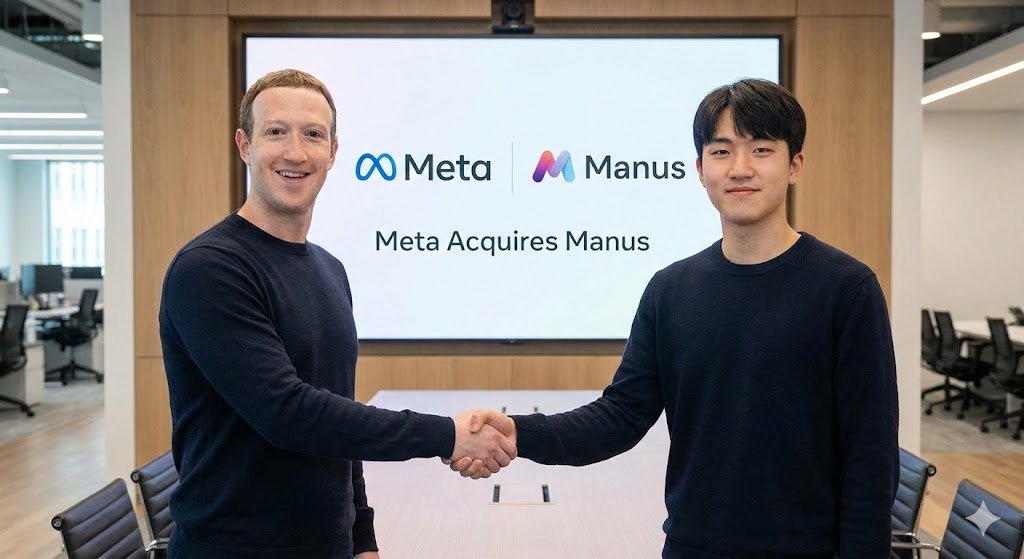
Singapore-based company reached $100M in annual revenue just eight months after launch, will continue operating while integrating into Meta’s products
Meta is making a major bet on AI agents, acquiring Manus — a Singapore-based startup building autonomous general-purpose assistants — for more than $2 billion, according to The Wall Street Journal.
The Facebook and Instagram owner announced the deal today but declined to disclose financial terms. Meta said it plans to continue operating and selling the Manus service while integrating the technology across its product suite, potentially bringing AI agent capabilities to billions of users.
What Manus does
Manus specializes in developing autonomous agents that can handle a range of complex tasks including market research, coding, data analysis, and even website creation. Unlike chatbots that simply respond to queries, these agents can execute multi-step workflows with minimal human intervention.
The company launched its general-purpose AI agent earlier this year, utilizing models from AI companies including Anthropic and Alibaba rather than building its own foundation models. That multi-provider approach allowed Manus to scale quickly — the company has served millions of users and businesses, processed more than 147 trillion tokens, and generated over 80 million virtual computers since launch.
Perhaps most impressively, Manus reached $100 million in annual recurring revenue just eight months after release, according to the WSJ report — a trajectory that explains Meta’s willingness to pay a significant premium over the company’s most recent valuation.
The acquisition terms
Manus raised $75 million in April in a funding round led by Benchmark that valued the company at $500 million. Meta’s reported $2 billion-plus acquisition price represents a 4x multiple in less than a year, underscoring how intensely Big Tech is competing for AI capabilities.
Benchmark, along with other Manus investors including HSG, ZhenFund, and Tencent, will see substantial returns on what was already a fast-growing investment.
Xiao Hong, who co-founded Manus and serves as CEO, will join Meta and report directly to Chief Operating Officer Javier Olivan. The majority of Manus’s approximately 100 employees are based in Singapore and will join Meta as part of the deal.
Strategic context
The acquisition fits into Meta’s broader AI strategy, which has emphasized building practical AI tools that work across its massive user base rather than just competing on foundation model capabilities. Meta already offers AI assistants across WhatsApp, Instagram, and Facebook, but Manus brings a level of autonomous task execution that goes beyond conversational interfaces.
“We are excited to announce that Manus is joining Meta to bring a leading agent to billions of people and unlock opportunities for businesses across our products,” Meta’s statement read.
The emphasis on business applications is notable. While consumer AI assistants have captured headlines, autonomous agents that can handle substantive business tasks — market research, competitive analysis, code generation — represent a potentially massive revenue opportunity, particularly for Meta’s advertising and business tools ecosystem.
The Singapore connection
Manus’s journey to Singapore reflects broader geopolitical currents in AI development. Initially established as Butterfly Effect in 2022 with offices in Beijing and Wuhan, the company relocated its headquarters to Singapore following investment from Benchmark.
That move positioned Manus in a jurisdiction increasingly viewed as a neutral ground for AI development — less exposed to US-China technology tensions while maintaining access to both markets and talent pools. Singapore has actively courted AI companies with favorable regulations and infrastructure investments, and Manus’s successful exit will likely encourage more startups to follow a similar path.
Why it matters
Meta’s acquisition signals that autonomous AI agents — systems that can execute complex multi-step tasks with minimal supervision — have moved from experimental technology to strategic necessity for tech platforms. While much AI investment has focused on improving foundation models, the real commercial value may lie in agent systems that can reliably accomplish business-critical tasks.
The speed of Manus’s growth, from launch to $100 million in ARR to a $2 billion-plus exit in under a year, also illustrates how compressed AI startup timelines have become. In previous technology cycles, reaching that scale might have taken five to seven years. In the AI era, companies that find product-market fit can scale at unprecedented velocity — and command acquisition prices to match.
For Meta, the deal represents a bet that bringing sophisticated AI agents to its billions of users will create new engagement loops and business model opportunities beyond its advertising core. Whether integrating Manus’s technology across WhatsApp, Instagram, and Facebook actually delivers on that vision remains to be seen, but Meta is clearly willing to pay a premium to find out.

Ali Tahir is a growth-focused marketing leader working across fintech, digital payments, AI, and SaaS ecosystems.
He specializes in turning complex technologies into clear, scalable business narratives.
Ali writes for founders and operators who value execution over hype.