
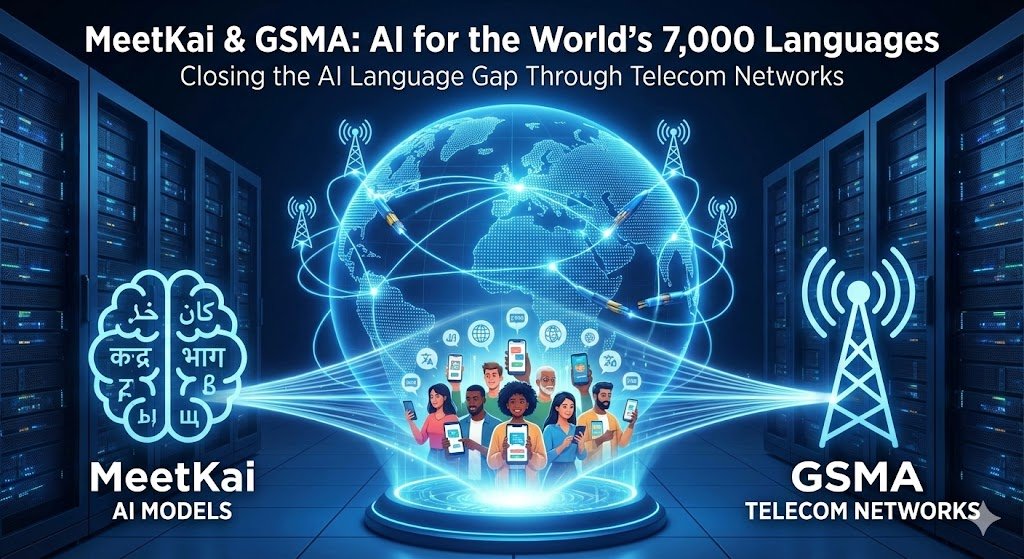
New initiative aims to close the “AI language gap” by developing culturally aligned models deployable through telecom networks
Of the nearly 7,000 languages spoken worldwide, fewer than 20 are considered “high-resource” for artificial intelligence — leaving billions of people effectively locked out of the AI revolution. Now a new partnership between MeetKai and the GSMA aims to change that by developing AI models for low-resource languages that can be deployed at scale through telecommunications infrastructure.
MeetKai, a company building what it calls “Sovereign AI” stacks for nations, announced the collaboration with the GSMA, the global industry organization representing mobile network operators, on Monday. The initiative will focus on creating efficient, culturally aligned language models that telecom networks can actually operate and deliver to communities at scale.
The language gap problem
The disparity in AI language support isn’t just a technical limitation — it’s a growing source of digital inequality. When AI systems can only understand and generate content in a handful of dominant languages, entire communities get excluded from essential services, economic opportunities, and participation in the digital economy.
That gap also perpetuates bias. AI models trained predominantly on English, Mandarin, and a few other high-resource languages encode the worldviews, cultural assumptions, and knowledge bases of those linguistic communities while systematically underrepresenting or misrepresenting others.
“We believe every country and every community should have the ability to shape its AI future,” said James Kaplan, CEO of MeetKai. “Collaborating with GSMA connects our model and evaluation capabilities with the world’s most powerful distribution layer: telecommunications networks. Together, we aim to deliver practical, culturally aligned AI that can serve people at scale.”
Why telecom networks matter
The partnership’s emphasis on telecommunications infrastructure is strategic. In many parts of the world, mobile networks represent the primary — and sometimes only — way people access digital services. By developing AI models optimized for deployment through telecom infrastructure, the initiative aims to reach communities that might never access cloud-based AI services through traditional internet connections.
“Mobile networks are particularly well-positioned to help ensure AI is inclusive, locally relevant, and accessible,” said Louis Powell, Director of AI Technologies at GSMA. “This collaboration with MeetKai strengthens the GSMA’s ability to close the AI Language gap by catalyzing work on language models, evaluation frameworks, and responsible data approaches.”
The initiative will also develop evaluation benchmarks and data-audit methodologies — critical infrastructure for assessing whether AI models actually work well for specific languages and cultural contexts rather than just technically functioning.
Why it matters
As AI becomes embedded in everything from healthcare diagnostics to financial services to government administration, language support determines who can participate. Communities speaking low-resource languages risk being permanently marginalized in an AI-driven economy unless deliberate efforts address the gap.
The challenge is partly technical — training high-quality AI models requires substantial datasets, and low-resource languages by definition lack the digital corpora that high-resource languages have accumulated. But it’s also economic: there’s limited commercial incentive for tech giants to invest in languages with relatively small speaker populations, even if those populations number in the millions.
Partnerships like this one attempt to solve both problems by pooling resources and leveraging existing infrastructure. Whether the initiative can deliver at the scale it promises remains to be seen, but it represents one of the more concrete efforts yet to ensure AI development doesn’t leave most of the world’s linguistic diversity behind.
For MeetKai, which positions itself around building national AI infrastructure, the collaboration extends its “Sovereign AI” pitch — the idea that countries and communities should control their own AI capabilities rather than depending entirely on models built by American or Chinese tech giants. Adding linguistic and cultural alignment to that sovereignty argument could resonate with governments and telecom operators looking for alternatives to dominant AI platforms.

Ali Tahir is a growth-focused marketing leader working across fintech, digital payments, AI, and SaaS ecosystems.
He specializes in turning complex technologies into clear, scalable business narratives.
Ali writes for founders and operators who value execution over hype.