

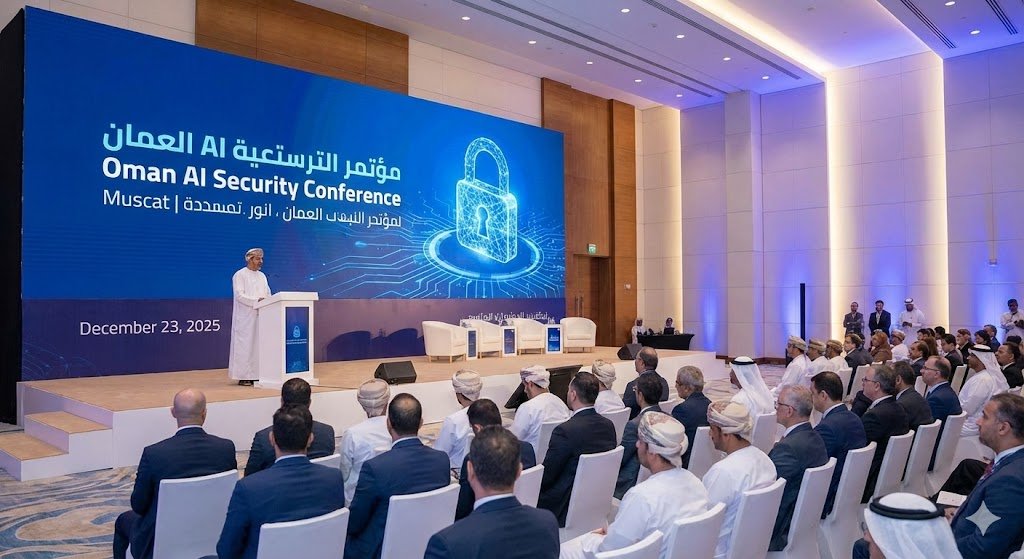
Security experts at a major conference in Muscat have warned that while artificial intelligence security capabilities are advancing rapidly, the sophistication of cyber threats is evolving at an equally alarming pace, with hackers now able to breach networks and extract data in minutes rather than weeks.
The Oman AI Security Conference, inaugurated Tuesday by Eng Said bin Hamoud al Maawali, Minister of Transport, Communications and Information Technology, brought together industry leaders and government officials to address the escalating challenges posed by AI-powered cyber attacks and emerging quantum computing threats.
From Weeks to Minutes
Raed Abudayyeh from Palo Alto Networks illustrated the dramatic acceleration in cyber attack capabilities during a conference session on cybersecurity in the age of AI.
“Five years ago, this was in weeks. Three to four years ago, it was done in 48 hours. Now it is in minutes,” Abudayyeh said, describing how quickly attackers can penetrate networks and exfiltrate data. “They go from your network all the way to getting data out. So attackers are leveraging AI massively.”
Human Capital as Security Foundation
Said bin Abdullah al Mandhari, CEO of ITHCA Group, emphasized in his keynote address that technological advancement alone cannot address security challenges without substantial investment in human expertise.
“AI security is not anymore the security of infrastructure. It is the trust of data models, and all this comes with trusted, talented, and accountable people to serve the purpose,” Al Mandhari said in an interview. “Therefore, the governments have to invest in talents, and the talents will make the difference in how AI security can be achieved.”
Al Mandhari framed the issue in terms of national sovereignty, arguing that only domestic talent can adequately protect a nation’s digital infrastructure and data.
Data Governance Challenges
Krishnadas KT, co-founder and CEO of Securado, highlighted fundamental challenges in how artificial intelligence systems handle data, noting that information fed into AI systems often cannot be deleted or erased once processed.
“This conference is not about technology, but it is about responsibility. Responsibility for how AI has been governed and processed,” Krishnadas said. “Most of the time when data is fed to AI, it can neither be deleted or erased and this poses a big threat to society. It is not a problem for the industry but is a problem for human privacy.”
He pointed out that governance policies for data fed into large language models remain largely absent, creating significant risks as AI systems transform data into permanent knowledge.
Post-Quantum Threats
Conference participants also addressed emerging threats from quantum computing, which experts warn will render many current encryption methods ineffective. This development, combined with increasingly autonomous AI-powered attacks operating at machine speed, presents what speakers described as an urgent security challenge.
Securado has developed what it calls a “Digital Vaccine,” described as an evolution of Managed Security Services designed for an AI-first, quantum-ready environment. According to Krishnadas, the system continuously identifies attack patterns, learns from attempted breaches, and builds defense mechanisms proactively rather than reactively.
Oman’s Strategic Response
Dr Fatma al Maqbali, representing the Oman Chamber of Commerce and Industry, outlined key challenges for building cyber-resilient governments, including the speed of AI threats versus policy development, skills gaps in AI cybersecurity, and dependence on external vendors.
She proposed a phased roadmap for Oman: short-term AI risk assessment, medium-term focus on policy and skills development, and long-term implementation of adaptive cyber governance frameworks.
The conference’s focus aligns with Oman Vision 2040, the country’s long-term development strategy. Organizers stated the event aims to promote responsible use of artificial intelligence to protect digital environments, enhance cyber defenses, and encourage ethical innovation.
The conference featured two panel discussions examining C-suite strategies for AI-powered transformation and the evolving threat landscape of AI risks and opportunities.
