
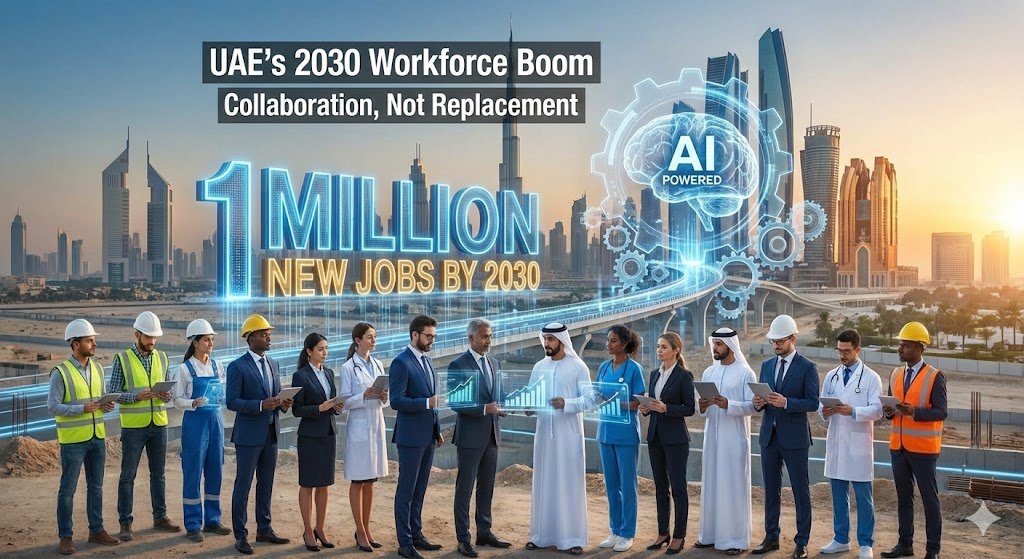
A new forecast challenges the doom-and-gloom narrative about automation replacing jobs. In the Emirates, AI adoption is expected to create roles, not just eliminate them.
By Ali T. | Dec 23, 2025
For all the hand-wringing about AI stealing jobs, here’s a data point that cuts the other way: The UAE will probably need to add around 1 million workers by 2030, driven in large part by its aggressive push into digitization and artificial intelligence.
That’s according to a new skills forecast report from enterprise software company ServiceNow and education firm Pearson, which analyzed workforce trends across nine countries. And the UAE’s projected 12.1 percent workforce increase stands out — it’s one of the highest among the markets studied, outpacing major economies like the US (2.1 percent), the UK (2.8 percent), and even India (10.6 percent).
The takeaway? At least in the UAE’s case, AI isn’t replacing humans en masse. It’s creating demand for more of them.
Where the jobs are coming from
The report points to growth across multiple sectors: manufacturing, education, retail, finance, healthcare, and energy. And crucially, the UAE will need more than 91,000 additional technology specialists by 2030 to keep the digital transformation humming along.
In-demand roles include search marketing strategists, programmers, and computer systems analysts — the kind of jobs that exist because of AI adoption, not in spite of it. The implication is clear: deploying AI at scale requires armies of people to build, maintain, tune, and troubleshoot the systems.
William O’Neill, ServiceNow’s GCC vice president, framed it as a collaborative future. “The future of work depends on collaboration between people and AI, and it’s a future that’s hiring now,” he said, emphasizing that upskilling will be essential to capture what he called “the next wave of economic growth.”
The UAE’s AI ambitions, quantified
This workforce projection aligns with the UAE’s well-documented ambitions to become an AI powerhouse as it diversifies away from oil. The country has been aggressively courting tech giants — Microsoft, Nvidia, and OpenAI have all established partnerships or investments in the region. Just this year, the UAE teamed up with the US to develop an AI campus in Abu Dhabi featuring 5 gigawatts of capacity for AI data centers.
That’s not just infrastructure for show. It’s infrastructure that requires people: data scientists, cloud engineers, compliance specialists, facility managers, and countless other roles that didn’t exist a decade ago.
The ServiceNow-Pearson report suggests that eight out of the 10 countries analyzed will need additional workers to support projected economic growth. The exceptions? Germany and Japan, where demographic decline and already-high tech adoption rates are expected to shrink workforces — but those are outlier cases driven by population trends, not automation alone.
The AI jobs debate, still raging
Of course, this rosy forecast exists against a backdrop of considerable anxiety about AI’s impact on employment. Public sentiment on AI has grown more skeptical, particularly in the US, where a recent Pew Research Center poll revealed a widening gap between experts and the general public.
Tech experts were far more likely — 56 percent compared to just 17 percent of average Americans — to say AI would have a positive impact on society over the next 20 years. That’s a trust gap, and it reflects genuine concerns about displacement, especially as so-called “agentic AI” systems begin automating complex decision-making tasks traditionally performed by humans.
The ServiceNow-Pearson report acknowledges this risk, noting that finance sector roles could face the most disruption from agentic AI. Broadly speaking, agentic AI refers to systems capable of autonomously handling multi-step workflows — think AI agents that can manage financial portfolios, process loan applications, or reconcile accounts without human intervention.
Augmentation, not replacement (for now)
But the report’s broader argument is that AI is primarily augmenting work rather than wholesale replacing it. At least in the near term, and at least in economies like the UAE that are rapidly scaling up digital infrastructure.
O’Neill put it plainly: “What we are seeing in the UAE, as well as in nearly every other country surveyed, is that AI augmentation will be central to capturing the next wave of economic growth.”
That framing — augmentation versus replacement — has become the go-to talking point for tech companies eager to calm fears about automation. And to be fair, history suggests that technology tends to create new categories of work even as it eliminates old ones. The question is always: how quickly, how equitably, and for whom?
The upskilling imperative
The ServiceNow-Pearson forecast hinges on one critical assumption: that workers can be trained fast enough to fill these emerging roles. That means massive investments in education, reskilling programs, and digital literacy initiatives — none of which are guaranteed.
The UAE has been pouring resources into AI research, startup ecosystems, and partnerships with global tech leaders. But whether that translates into a workforce ready to fill 91,000+ tech specialist roles remains to be seen. It’s one thing to build data centers and attract investment. It’s another to ensure people have the skills to work in them.
For now, though, the numbers tell an optimistic story: In a region betting big on AI, the technology isn’t killing jobs. It’s multiplying them.
At least until the next wave of automation arrives.

Ali Tahir is a growth-focused marketing leader working across fintech, digital payments, AI, and SaaS ecosystems.
He specializes in turning complex technologies into clear, scalable business narratives.
Ali writes for founders and operators who value execution over hype.