

The former Yahoo and Google exec is making another consumer bet, this time on generative AI — with Forerunner’s Kirsten Green leading the round
Marissa Mayer is back with a new startup, and this time she’s betting on AI personal assistants to deliver the kind of transformative consumer product that’s eluded her since leaving Yahoo.
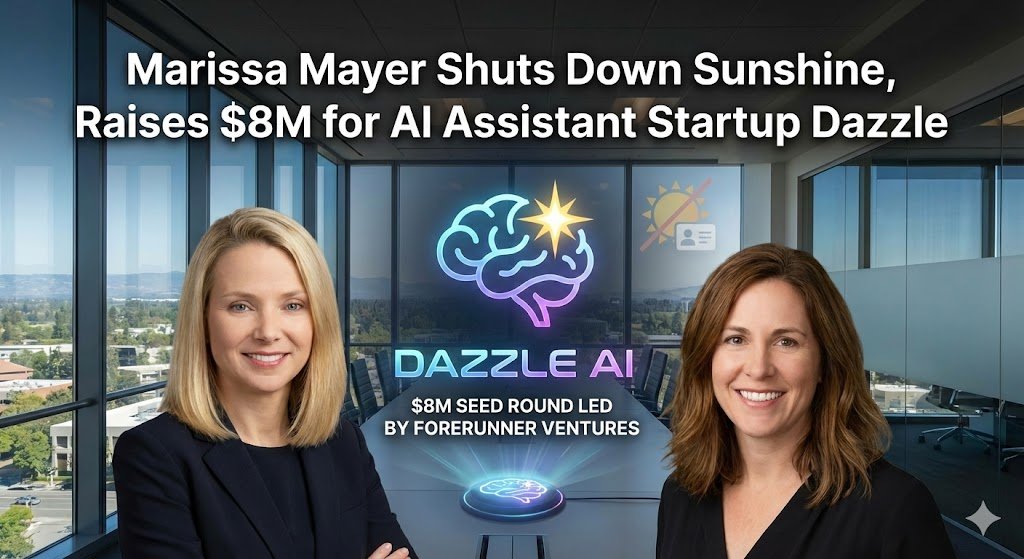
The former Yahoo CEO announced today that she’s shuttering Sunshine, her six-year-old photo-sharing and contact-management startup, to focus on Dazzle, a new company building what Mayer describes as “the next generation of AI personal assistants.” Dazzle has raised an $8 million seed round at a $35 million valuation, led by Forerunner Ventures’ Kirsten Green.
A credibility play
Landing Green as lead investor is a significant get for Mayer, particularly coming off Sunshine’s widely acknowledged struggles. Green has a track record of spotting breakout consumer brands early — Warby Parker, Chime, and Dollar Shave Club all count among Forerunner’s portfolio wins.
The round also includes participation from Kleiner Perkins, Greycroft, Offline Ventures, Slow Ventures, and Bling Capital. While Mayer confirmed she invested her own capital, she emphasized that Green led the round — a detail that signals institutional validation for the pivot.
“I think she really has a great sense for where people and platforms are going,” Mayer said of Green.
Green previously told TechCrunch that while enterprise AI dominated the early phase of this technology cycle, consumer-facing AI is a “late bloomer” finally ready for its moment. That thesis appears to be driving her bet on Dazzle.
From Sunshine to Dazzle
Mayer isn’t sharing specifics about Dazzle’s functionality yet — the company’s website, dazzle.ai, is currently password-protected — but she told TechCrunch the team began prototyping last summer and quickly realized they’d found something with far more potential than Sunshine.
“We realized that this was something that we were much more excited about,” Mayer said, noting Dazzle has the opportunity for “a much bigger impact.”
That’s a stark admission about Sunshine’s shortcomings. Originally founded as Lumi Labs in 2018, the company launched with “Sunshine Contacts,” a subscription app for contact management that struggled from day one. Privacy advocates flagged the app’s practice of pulling home addresses from public databases to auto-populate contact lists, and the product never recovered from the initial backlash.
By 2024, Sunshine had pivoted to add event management tools and “Shine,” an AI-powered photo-sharing feature. The redesigned offering was panned for its dated design and failed to gain traction.
Over its lifetime, Sunshine raised $20 million from investors including Felicis, Norwest Venture Partners, and Unusual Ventures. When the company dissolved, those investors received 10% of Dazzle’s equity, according to Mayer.
Lessons learned
Mayer was unusually candid about what went wrong with Sunshine, acknowledging the problems it tackled were too “mundane” and not ambitious enough.
“I don’t think we got it to the state of overall polish and accessibility that I really wanted it to be,” she added.
Now she’s betting those lessons will translate into a more resilient business with Dazzle. Mayer pointed to her track record at Google — where she was employee number 20 and helped shape Google Search, Maps, and AdWords — and Yahoo as proof she knows how to build products that change behavior at scale.
“I have had the rare privilege of being at two companies that really changed how people do things,” Mayer told TechCrunch. “Yahoo, for many, defined the internet. Google, in terms of Search and Maps, changed everything. I really aspire to build a product that has that kind of impact again.”
Why it matters
The AI personal assistant space is already crowded, with everyone from OpenAI to startups like Inflection and Character.AI competing for attention. But Mayer’s pedigree — and Green’s backing — suggest Dazzle isn’t just another chatbot wrapper.
The real question is whether Mayer can translate her product instincts from the early web and mobile eras into the AI-native consumer landscape. Sunshine’s failure shows that founder reputation alone isn’t enough, but the speed with which she pivoted and secured backing from a top-tier consumer investor suggests she’s learned from those mistakes.
Dazzle is expected to emerge from stealth early next year. Until then, the specifics of what Mayer is building — and whether it can live up to her ambitions — remain under wraps.
