
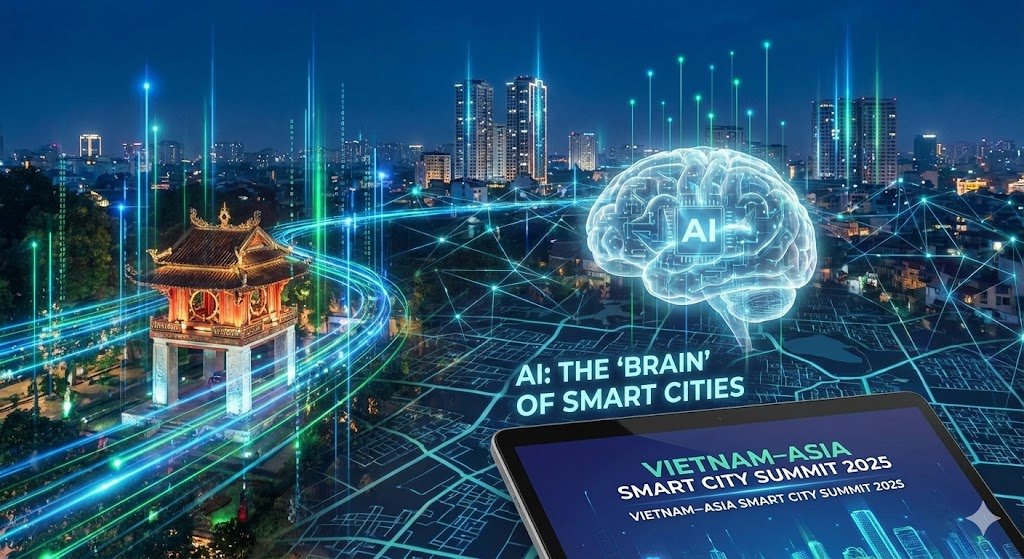
At a major summit in Hanoi, officials and tech leaders laid out how artificial intelligence is fundamentally reshaping urban governance — not just adding features, but rebuilding how cities think
By Ali T. | Dec 23, 2025
Forget sensors and apps. The next generation of smart cities isn’t about digitizing what already exists — it’s about using AI to fundamentally rewire how cities make decisions, respond to crises, and serve millions of residents in real time.
That was the core message from more than 600 policymakers, tech executives, and urban planners who gathered in Hanoi this week for the Vietnam–Asia Smart City Summit 2025. And if the language coming out of the conference sounds ambitious, that’s because it is: participants repeatedly described AI not as a “tool” but as the “new brain” of urban governance itself.
“A smart city is not about having more sensors or software, but about connectivity between government, enterprises, citizens and communities,” said Nguyễn Văn Khoa, chairman of the Vietnam Software and IT Services Association (VINASA), which co-organized the summit with Hanoi’s municipal government.
From reactive to proactive governance
The shift isn’t subtle. Vietnamese cities are moving beyond basic digitization — scanning documents, putting forms online — toward what speakers called “data- and AI-driven operations.” That means using machine learning to predict traffic bottlenecks before they happen, simulate policy outcomes before implementation, and detect infrastructure failures before they cascade.
Phạm Quang Nhật Minh, who directs FPT IS’s AI Research and Development Centre, framed the problem bluntly: cities are drowning in data but starved for insight. “AI helps authorities gradually shift from reactive management to a more proactive approach,” he said, describing systems that can forecast demand, monitor environmental threats, and personalize public services while keeping humans in the decision-making loop.
Phan Thị Thanh Ngọc from VNPT AI was even more direct: “AI is considered the ‘brain’ of smart cities.”
Da Nang’s six-year winning streak
The proof, as they say, is in the deployment. At the summit, VINASA announced its 2025 Smart City Awards, and Da Nang — a coastal city that’s been building smart infrastructure since 2018 — walked away with top honors for the sixth consecutive year.
Da Nang’s playbook? Start with open data. The city has published more than 1,500 datasets publicly accessible to government agencies, businesses, and residents. Then layer on AI for specific pain points: tracking floods and rainfall, managing traffic flow, monitoring air quality, flagging overdue administrative paperwork.
Trần Ngọc Thạch from Da Nang’s Department of Science and Technology said the results speak for themselves: fewer overdue case files, better service quality, and faster emergency response times.
Hanoi, meanwhile, earned recognition for its AI-powered citizen engagement tools, including a 24/7 hotline, virtual assistant, and the iHanoi app — part of the capital’s push to become what Vice Chairman Trương Việt Dũng called “a leading innovation hub.”
The people-centered pitch
Amid all the talk of algorithms and data platforms, summit organizers were careful to emphasize one thing: technology is a means, not an end. VINASA even included a nationwide public vote for “Most Liveable City” as part of the awards — a reminder that no amount of AI sophistication matters if residents’ lives don’t actually improve.
Khoa, the VINASA chairman, put it plainly: smart cities place “people at the centre, with government acting as a facilitator, businesses as the driving force and technology as a tool.”
That framing is critical as Vietnam enters what speakers described as a “pivotal year” for urban tech. The country is now implementing Decree 269 on smart urban development while racing toward net-zero emissions targets. And with infrastructure overload, pollution, and population growth intensifying across Vietnamese cities, the pressure to deliver results — not just demos — is mounting.
The interoperability challenge
Of course, all this AI-powered governance depends on something decidedly less sexy: robust data infrastructure and coordination across agencies. Participants acknowledged that fragmented systems remain a major barrier, and that connecting isolated platforms into a “unified whole” is easier said than done.
The summit’s five thematic workshops tackled exactly these issues, diving into intelligent transport, environmental monitoring, energy optimization, and online public services. The consensus? Success requires what one speaker called “interoperability across data, processes, policies and resources” — which is to say, the hard, unglamorous work of getting different government departments and private vendors to actually talk to each other.
As the conference wrapped, VINASA emphasized that the awards would continue evolving “to promptly recognise outstanding achievements” and help cities replicate effective models. Translation: this is a marathon, not a sprint.
But if Vietnam’s cities can pull it off — building AI systems that are transparent, effective, and genuinely responsive to residents — they might just offer a blueprint for urban governance in the age of machine learning. And that would be smarter than any sensor network.

Ali Tahir is a growth-focused marketing leader working across fintech, digital payments, AI, and SaaS ecosystems.
He specializes in turning complex technologies into clear, scalable business narratives.
Ali writes for founders and operators who value execution over hype.